
Pretrained Deep Learning Models for Classifying Plant Species: A Comparative Study in Balikpapan Botanical Gardens
DOI:
https://doi.org/10.35718/iiair.v2i1.8481959Keywords:
Plant Species Classification, Comparative Deep Learning Models, Convolutional Neural Networks, Balikpapan Botanical Garden, Deep Learning, Computer Vision, Machine LearningAbstract
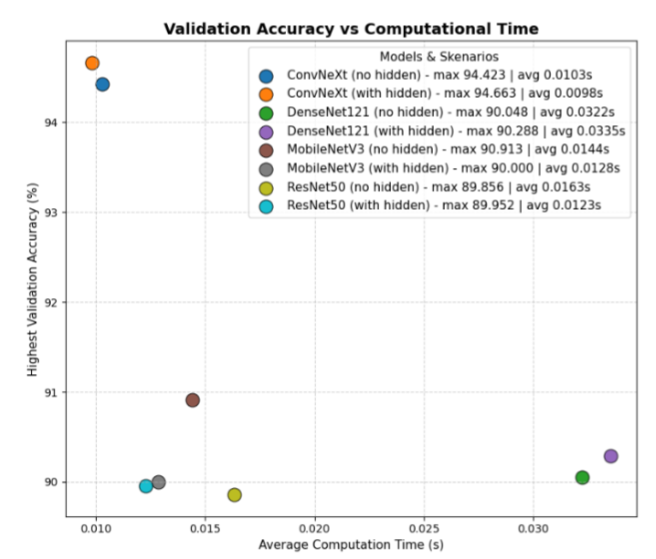
Urban plant biodiversity is crucial for maintaining ecosystem functioning, yet it faces numerous serious threats such as infrastructure development, habitat fragmentation, pollution, and climate change. Species inventory is also challenging due to limited data and changes in scientific nomenclature. To address this, various conservation efforts are being carried out, all of which require accurate species identification. However, manual classification is often inefficient and inaccurate due to similarities between species as well as variations within a single species. Therefore, automated approaches based on machine learning, such as Convolutional Neural Networks (CNN) are used to assist plant classification, although challenges remain, including data imbalance and high image variability. Various CNN architectures have been developed, and no single model outperforms others in all situations. Therefore, the choice must be tailored to the characteristics of the task and the dataset being used. This study aims to compare the performance of several pretrained models and determine the most optimal one for classifying plant species in natural images from the Balikpapan Botanical Garden (BBG52). The focus of this research is to evaluate the performance of four CNN architectures (ResNet50, DenseNet121, MobileNetV3 Large, and ConvNeXt Tiny), all of which are pretrained models with weights obtained from training on the ImageNet dataset. This study employs two configurations (without additional hidden layers and with the addition of one hidden layer) to examine the effect of the number of hidden layers on model performance, and evaluates them based on accuracy, F1-score, and computation time. The results of this study show that ConvNeXt Tiny with the added hidden-layer configuration is the most optimal model for plant species classification on the BBG52 dataset, achieving the highest accuracy (94.66%), the highest F1-score (0.946), and the fastest computation time (0.0098 seconds) using a GPU. These findings provide practical guidance for selecting efficient and high-performing CNN architectures for real-world plant species classification in biodiversity conservation contexts.
References
[1] Zhao, X., Li, F., Yan, Y., & Zhang, Q. (2022). Biodiversity in Urban Green Space: A Bibliometric Review on the Current Research Field and Its Prospects. In International Journal of Environmental Research and Public Health (Vol. 19, Issue 19). MDPI. https://doi.org/10.3390/ijerph191912544.
[2] Christenhusz, M. J. M., & Byng, J. W. (2016). The number of known plants species in the world and its annual increase. In Phytotaxa (Vol. 261, Issue 3, pp. 201–217). Magnolia Press. https://doi.org/10.11646/phytotaxa.261.3.1.
[3] Araújo, V. M., Britto Jr., A. S., Oliveira, L. S., & Koerich, A. L. (2022). Two-view fine-grained classification of plant species. Neurocomputing, 467, 427–441. https://doi.org/10.1016/j.neucom.2021.10.015.
[4] Sterkenburg, T. F., & Grünwald, P. D. (2021). The no-free-lunch theorems of supervised learning. Synthese, 199(3–4), 9979–10015. https://doi.org/10.1007/s11229-021-03233-1.
[5] Ramadhani, R., Alfarisy, G. A. F., & Pratama. B. M. (2025). BBG52: A New Dataset for Plant Species Recognition in the Balikpapan Botanical Gardens, Borneo Island, Innovative Informatics and Artificial Intelligence Research (Vol. 1, Issue 1), 19-25. https://doi.org/10.35718/iiair.v1i1.127.
[6] Salsabila, S., & Suharso, A. (2024). Comparison of Deep Learning Architectures in Identifying Types of Medicinal Plant Leaf Images. In Journal of Applied Informatics and Computing (JAIC) (Vol. 8, Issue 1). http://jurnal.polibatam.ac.id/index.php/JAIC.
[7] Bui, H. P., Dinh, A. T., Nguyen, N. M., & Pham, V. K. (2023). A Quantitative Comparison of Classification Methods for Plant Leaf Images. Frontiers in Artificial Intelligence and Applications, 374, 52–59. https://doi.org/10.3233/FAIA230767.
[8] Dey, B., Ferdous, J., Ahmed, R., & Hossain, J. (2024). Assessing deep convolutional neural network models and their comparative performance for automated medicinal plant identification from leaf images. Heliyon, 10(1). https://doi.org/10.1016/j.heliyon.2023.e23655.
[9] Zhou, C. L., Ge, L. M., Guo, Y. B., Zhou, D. M., & Cun, Y. P. (2021). A comprehensive comparison on current deep learning approaches for plant image classification. Journal of Physics: Conference Series, 1873(1). https://doi.org/10.1088/1742-6596/1873/1/012002.
[10] Mehdipour Ghazi, M., Yanikoglu, B., & Aptoula, E. (2017). Plant identification using deep neural networks via optimization of transfer learning parameters. Neurocomputing, 235, 228–235. https://doi.org/10.1016/j.neucom.2017.01.018.
[11] Hama, H. M., Abdulsamad, T. Sh., & Omer, S. M. (2024). Houseplant leaf classification system based on deep learning algorithms. Journal of Electrical Systems and Information Technology, 11(1). https://doi.org/10.1186/s43067-024-00141-5.
[12] Khalid, F., & Romle, A. A. (2024). Herbal Plant Image Classification using Transfer Learning and Fine-Tuning Deep Learning Model. Journal of Advanced Research in Applied Sciences and Engineering Technology Journal Homepage: Journal of Advanced Research in Applied Sciences and Engineering Technology, 35(1), 16–25. https://doi.org/10.37934/araset.35.1.1625.
[13] Gustineli, M., Miyaguchi, A., & Stalter, I. (2024). Multi-Label Plant Species Classification with Self-Supervised Vision Transformers. http://arxiv.org/abs/2407.06298.
[14] Lapkovskis, A., Nefedova, N., & Beikmohammadi, A. (2025). Automatic Fused Multimodal Deep Learning for Plant Identification. https://doi.org/10.3389/fpls.2025.1616020.
[15] Mareta Tama, A., & Candra Noor Santi, R. (2023). Klasifikasi Jenis Tanaman Hias Menggunakan Metode Convolutional Neural Network (CNN) Ornamental Plant Classification Using The Convolutional Neural Network (CNN) Method. Journal of Information Technology and Computer Science (INTECOMS), 6(2).
[16] Duta, I. C., Liu, L., Zhu, F., & Shao, L. (2020). Improved Residual Networks for Image and Video Recognition. http://arxiv.org/abs/2004.04989.
[17] Huang, G., Liu, Z., van der Maaten, L., & Weinberger, K. Q. (2017). Densely Connected Convolutional Networks. https://github.com/liuzhuang13/DenseNet.
[18] Khasoggi, B., Ermatita, & Samsuryadi. (2019). Efficient mobilenet architecture as image recognition on mobile and embedded devices. Indonesian Journal of Electrical Engineering and Computer Science, 16(1), 389–394. https://doi.org/10.11591/ijeecs.v16.i1.pp389-394.
[19] Howard, A., Sandler, M., Chu, G., Chen, L.-C., Chen, B., Tan, M., Wang, W., Zhu, Y., Pang, R., Vasudevan, V., Le, Q. v, Adam, H., Ai, G., & Brain, G. (n.d.). Searching for MobileNetV3.
[20] Liu, Z., Mao, H., Wu, C.-Y., Feichtenhofer, C., Darrell, T., Xie, S., & Research, F. A. (2022). A ConvNet for the 2020s. https://github.com/facebookresearch/ConvNeXt.
[21] Nugroho, R. A., Syafitri, E. D., & Yorika, R. (2021). Konsep Pengembangan Kebun Raya Balikpapan Sebagai Destinasi Wisata Alam Unggulan. Jurnal Pembangunan Wilayah Dan Kota, 17(3), 307–315. https://doi.org/10.14710/pwk.v17i3.33569.
Downloads
Published
How to Cite
License
Copyright (c) 2026 Innovative Informatics and Artificial Intelligence Research

This work is licensed under a Creative Commons Attribution 4.0 International License.
