
Analysis of Lightweight Pretrained Deep Learning Models for Bird Species Classification
DOI:
https://doi.org/10.35718/iiair.v2i1.8481939Keywords:
bird spesies classification, deep learning, lightweight models, transfer learning, MobileViT, CNN, Vision TransformerAbstract
Bird biodiversity plays a vital role in maintaining ecological balance but is highly vulnerable to urbanization and environmental degradation. Manual identification of bird species requires considerable time and expertise, making automated classification systems essential. This study develops an efficient bird species classification framework
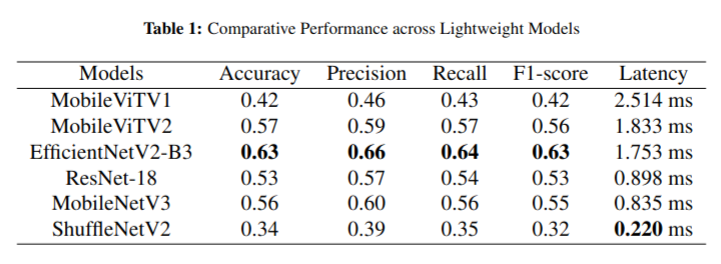
using lightweight deep learning models. Six pretrained architectures were evaluated: MobileViT-V1, MobileViT-V2, EfficientNetV2-B3, ResNet-18, MobileNetV3, and ShuffleNetV2. The dataset, obtained from TensorFlow Dataset, consists of 200 bird species with a total of 11,788 images. Results indicate that EfficientNetV2-B3 achieved the highest accuracy (63%) and F1-score (0.63). MobileNetV3 provided a balanced trade-off with 56% accuracy and 0.835 ms latency, making
it optimal for deployment on resource-constrained devices.
References
[1] T. Lamba, H. H. Pontororing, and Saroyo, “Biodiversitas burung pada beberapa tipe habitat di kampus universitas samratulangi manado dalam masa pandemi covid-19,” JURNAL LPPM BIDANG SAINS DAN TEKNOLOGI, vol. 7, no. 2, p. 27–32, Oct. 2022, doi: 10.35801/jlppmsains.7.2.2022.47488 . [Online]. Available: https://ejournal.unsrat.ac.id/v3/index.php/lppmsains/article/view/47488
[2] R. Fabrina and U. Faizah, “Keanekaragaman dan kelimpahan jenis burung di kawasan mangrove bee jay bakau resort (BJBR) kota probolinggo,” Sains & Mat, vol. 7, no. 1, pp. 1–7, Apr. 2022, doi: 10.26740/sainsmat.v7n1.p1-7.
[3] https://burung.org/author/burung admin/, “Status Burung di Indonesia 2024 — burung.org,” https://www.burung.org/en/status-burung-di-indonesia-2024/, [Accessed 19-11-2024].
[4] H.-T. Vo, N. N. Thien, and K. C. Mui, “Bird detection and species classification: Using yolov5 and deep transfer learning models,” International Journal of Advanced Computer Science and Applications, vol. 14, no. 7, 2023, doi: 10.14569/IJACSA.2023.01407102. [Online]. Available: http://dx.doi.org/10.14569/IJACSA.2023.01407102
[5] D. F. Lestari and I. Kurnia, “Keanekaragaman jenis burung pada berbagai tipe habitat di pulau belitung,” Bioscientist : Jurnal Ilmiah Biologi, vol. 11, no. 1, p. 1–19, Jun. 2023, doi: 10.33394/bioscientist.v11i1.6725. [Online]. Available: https://e-journal.undikma.ac.id/index.php/ bioscientist/article/view/6725
[6] A. H. Abdel-aziem and T. H. M. Soliman, “A Multi-Layer Perceptron (MLP) Neural Networks for Stellar Classification: A Review of Methods and Results,” International Journal of Advances in Applied Computational Intelligence, no. Issue 2, pp. 29–37, Jan. 2023, doi: 10.54216/IJAACI.030203. [Online]. Available: https://www.americaspg.com/articleinfo/31/show/2002
[7] M. M. Taye, “Theoretical understanding of convolutional neural network: Concepts, architectures, applications, future directions,” Computation, vol. 11, no. 3, 2023, doi: 10.3390/computation11030052. [Online]. Available: https://www.mdpi.com/2079-3197/11/3/52
[8] L. Alzubaidi, J. Zhang, A. J. Humaidi, A. Al-Dujaili, Y. Duan, O. Al-Shamma, J. Santamaría, M. A. Fadhel, M. Al-Amidie, and L. Farhan, “Review of deep learning: concepts, CNN architectures, challenges, applications, future directions,” J. Big Data, vol. 8, no. 1, p. 53, Mar. 2021, doi: 10.1186/s40537-021-00444-8.
[9] B. Wu, C. Xu, X. Dai, A. Wan, P. Zhang, Z. Yan, M. Tomizuka, J. Gonzalez, K. Keutzer, and P. Vajda, “Visual transformers: Token-based image representation and processing for computer vision,” 2020, doi: 10.48550/arXiv.2006.03677. [Online]. Available: https://arxiv.org/abs/2006.03677
[10] Y.-P. Huang and H. Basanta, “Bird image retrieval and recognition using a deep learning platform,” IEEE Access, vol. 7, pp. 66 980–66 989, 2019, doi: 10.1109/ACCESS.2019.2918274.
[11] X. Zhao, L. Wang, Y. Zhang, X. Han, M. Deveci, and M. Parmar, “A review of convolutional neural networks in computer vision,” Artif. Intell. Rev., vol. 57, no. 4, Mar. 2024, doi: 10.1007/s10462-024-10721-6.
[12] Z. Wang, J. Wang, C. Lin, Y. Han, Z. Wang, and L. Ji, “Identifying habitat elements from bird images using deep convolutional neural networks,” Animals, vol. 11, no. 5, 2021, doi: 10.3390/ani11051263. [Online]. Available: https://www.mdpi.com/2076-2615/11/5/1263
[13] G. K. Pandey and S. Srivastava, “Resnet-18 comparative analysis of various activation functions for image classification,” in 2023 International Conference on Inventive Computation Technologies (ICICT), 2023, pp. 595–601, doi: 10.1109/ICICT57646.2023.10134464.
[14] M. Tan and Q. Le, “EfficientNet: Rethinking model scaling for convolutional neural networks,” in Proceedings of the 36th International Conference on Machine Learning, ser. Proceedings of Machine Learning Research, K. Chaudhuri and R. Salakhutdinov, Eds., vol. 97. PMLR, 09–15 Jun 2019, pp. 6105–6114. [Online]. Available: https://proceedings.mlr.press/v97/tan19a.html
[15] S. Qian, C. Ning, and Y. Hu, “Mobilenetv3 for image classification,” in 2021 IEEE 2nd International Conference on Big Data, Artificial Intelligence and Internet of Things Engineering (ICBAIE), 2021, pp. 490–497, doi: 10.1109/ICBAIE52039.2021.9389905.
[16] L.-L. Zhang, Y. Jiang, Y.-P. Sun, Y. Zhang, and Z. Wang, “Improvements based on shufflenetv2 model for bird identification,” IEEE Access, vol. 11, pp. 101 823–101 832, 2023, doi: 10.1109/ACCESS.2023.3314676.
[17] S. Mehta and M. Rastegari, “Mobilevit: Light-weight, general-purpose, and mobile-friendly vision transformer,” 2022, doi: 10.48550/arXiv.2110.02178. [Online]. Available: https://arxiv.org/abs/2110.02178
[18] V. R. M. Polisetty and S. Chokkalingam, “Efficient classification of bird species using photographic images: A mobilevit based approach,” in 2024 3rd International Conference on Artificial Intelligence For Internet of Things (AIIoT), 2024, pp. 1–6, doi: 10.1109/AIIoT58432.2024.10574683.
[19] R. Pillai, N. Sharma, D. Upadhyay, S. Devliyal, and G. Kaur, “Efficientnet-v2-b3 transfer learning for high-accuracy indian bird species classification,” in 2024 15th International Conference on Computing Communication and Networking Technologies (ICCCNT), 2024, pp. 1–6, doi: 10.1109/ICCCNT61001.2024.10724769.
[20] S. Mehta and M. Rastegari, “Separable self-attention for mobile vision transformers,” 2022, doi: 10.48550/arXiv.2206.02680. [Online]. Available: https://arxiv.org/abs/2206.02680
[21] S. A. Al-Showarah and S. T. Al-qbailat, “Birds identification system using deep learning,” International Journal of Advanced Computer Science and Applications, vol. 12, no. 4, 2021, doi: 10.14569/IJACSA.2021.0120434. [Online]. Available: http://dx.doi.org/10.14569/IJACSA.2021.0120434
[22] A. Howard, M. Sandler, G. Chu, L.-C. Chen, B. Chen, M. Tan, W. Wang, Y. Zhu, R. Pang, V. Vasudevan, Q. V. Le, and H. Adam, “Searching for mobilenetv3,” in Proceedings of the IEEE/CVF International Conference on Computer Vision (ICCV), October 2019.
[23] C. Wah, S. Branson, P. Welinder, P. Perona, and S. Belongie, California Institute of Technology, Tech. Rep. CNS-TR-2011-001, 2011
Downloads
Published
How to Cite
License
Copyright (c) 2026 Innovative Informatics and Artificial Intelligence Research

This work is licensed under a Creative Commons Attribution 4.0 International License.
