
Comparative Analysis of Turbulence Models for Gawn Series Propeller using CFD Method
DOI:
https://doi.org/10.35718/ismatech.v4i1.8481984Keywords:
Gawn Series Propeller, CFD, RANS, Thrust Coefficient, Torque CoefficientAbstract
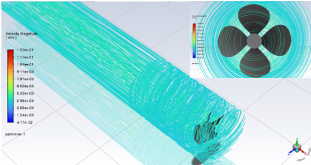
The rapid advancement of computational technology has positioned Computational Fluid Dynamics (CFD) as an effective tool for predicting marine propeller hydrodynamic performance. This study applies a CFD-based numerical method using Reynolds-Averaged Navier–Stokes (RANS) equations to evaluate and compare the accuracy of three turbulence models, namely k–ε, k–ω, and k–ω SST for a Gawn Series marine propeller. CFD simulations were conducted by varying the advance coefficient (J). Verification of the results for each turbulence model was carried out through Grid Independence Study and Grid Convergence Index analysis. The CFD simulation results were then compared with experimental test data using the Root Mean Square Error (RMSE) method, with KT, 10KQ, and efficiency as evaluation parameters. The results demonstrate that the k–ω SST model provides the most consistent and accurate predictions across the entire operating range, with RMSE values of 1.24% for KT, 1.98% for 10KQ, and 1.88% for efficiency. Pressure‑contour visualization from the k–ω SST model shows the smoothest pressure distribution on the blade surface, while pathline visualization reveals the clearest, most consistent, and well‑balanced vortex structures downstream of the propeller, thereby providing a robust and reliable basis for selecting the most suitable turbulence model to improve the accuracy of CFD based marine propeller performance prediction.
References
[1] D. R. Aldara, T. Irmiyana, A. L. F. Faisal, A. Ghofur, and R. Insani, “Strategi optimalisasi pemilihan propeller B-series untuk kapal: Studi kasus kapal tangker [B-series propeller selection optimization strategy for ships: A case study of a tanker]” Jurnal Teknik, vol. 13, no. 2, pp. 234–242, 2023.
[2] F. Tillig, J. W. Ringsberg, W. Mao, and B. Ramne, “A generic energy systems model for efficient ship design and operation,” Proceedings of the Institution of Mechanical Engineers, Part M: Journal of Engineering for the Maritime Environment, vol. 231, no. 2, pp. 649–666, 2017, doi: 10.1177/1475090216680672.
[3] R. Geertsma, R. R. Negenborn, K. Visser, and M. Loonstijn, “Pitch control for ships with diesel mechanical and hybrid propulsion: Modelling, validation and performance quantification,” Applied Energy, vol. 206, pp. 1609–1631, Nov. 2017, doi: 10.1016/j.apenergy.2017.09.103.
[4] I. Abdilla, C. Abar, D. Chrismianto, and P. Manik, “Analisa perbandingan propeller kapal selam tipe B-series dan AU-outline Gawn series pada kapal selam midget type 150M untuk mengoptimalkan kinerja kapal selam dengan metode CFD,” Jurnal Teknik Perkapalan, vol. 3, no. 4, 2015.
[5] M. Rakhim, A. Baidowi, and M. Indiaryanto, “Effect of Gawn Series Propeller Camber Ratio Variations on Fuel Consumption Using Engine Propeller Matching,” International Journal of Marine Engineering Innovation and Research, vol. 11, no. 1, pp. 37–56, Mar. 2026, doi: 10.12962/j25481479.v11i1.
[6] N. Nurhadi, H. Zen, and S. Sumarsono, “Study of engine propeller matching for high-speed vessel with Gawn series propeller,” EPI International Journal of Engineering, vol. 1, no. 1, pp. 39–42, 2018, doi: 10.25042/epi-ije.022018.07
[7] C. Kusuma, I. M. Ariana, W. H. Nugroho, E. B. Djatmiko, A. A. Masroeri, and Sutardi, “Design Propeller Of Fast Missile Boat 60 M By Using Gawn Series,” IOP Conference Series: Materials Science and Engineering, vol. 1052, no. 1, p. 012026, 2021, doi: 10.1088/1757-899X/1052/1/012026.
[8] K. Suastika, Dinamika Fluida Komputasi Metode Volume Hingga. Surabaya, Indonesia: ITS Press, 2023.
[9] M. M. Helal, T. M. Ahmed, A. A. Banawan, and M. A. Kotb, “Numerical prediction of the performance of marine propellers using computational fluid dynamics simulation with transition-sensitive turbulence model,” Proc. IMechE, Part M: Journal of Engineering for the Maritime Environment, vol. 233, no. 2, pp. 515–527, 2019, doi:10.1177/1475090218763199
[10] N. Shalom, “CFD analysis on marine propeller with various geometrical conditions,” Recent Research Reviews Journal, vol. 2, no. 2, pp. 242–255, 2023, doi:10.36548/rrrj.2023.2.002
[11] J. S. Carlton, Marine Propellers and Propulsion, 2nd ed. Oxford, U.K.: Butterworth Heinemann, 2007, pp. 1–533.
[12] S. B. Pope, Turbulent Flows. Cambridge, U.K.: Cambridge University Press, 2001, p. 773.
[13] H. Mikkelsen, M. L. Steffensen, “Full scale validation of CFD model of self-propelled ship,” M.S. thesis, Technical University of Denmark, Lyngby, Denmark, Jun. 2016, doi:10.13140/RG.2.2.25689.21607
[14] A. M. Ghoniem, A. S. A. Elazm, M. I. Benaya, and S. A. Mohamed, “Effect of salinity on marine propeller performance,” Journal of Physics: Conference Series, vol. 2616, no. 1, pp. 1–8, 2023, doi:10.1088/1742-6596/2616/1/012016
[15] Y. Li, S. Yang, F. Feng, and K. Tagawa, “A review on numerical simulation based on CFD technology of aerodynamic characteristics of straight-bladed vertical axis wind turbines,” Energy Reports, vol. 9, pp. 4360–4379, 2023, doi: 10.25042/epi-ije.052018.07
[16] P. J. Roache, “Perspective: A method for uniform reporting of grid refinement studies,” Journal of Fluids Engineering, vol. 116, pp. 405–413, 1994, doi: 10.1115/1.2910291.
[17] M. Indiariyanto, K. Suastika, T. A. Setyanto, and P. H. N. Prayoga, “Comparison of the hydrodynamic performance of three different propeller foil types: NACA 66 (Mod), ogival and NACA symmetrical section,” CFD Letters, vol. 17, no. 10, pp. 168–183, 2025, doi: 10.37934/cfdl.17.10.168183
[18] X. Wang and K. Walters, “Computational analysis of marine-propeller performance using transition-sensitive turbulence modeling,” Journal of Fluids Engineering, vol. 134, no. 7, pp. 1–10, 2012, doi: 10.1115/1.4005729.
[19] C. Parra, “Numerical investigation of the hydrodynamic performances of marine propeller,” M.S. thesis, 2013, pp. 1–104.
[20] R. Mehdipour, “Simulating propeller and propeller–hull interaction in OpenFOAM,” M.S. thesis, Royal Institute of Technology (KTH), Stockholm, Sweden, 2013, pp. 1–45.
[21] H. Peng, W. Qiu, and S. Ni, “Effect of turbulence models on RANS computation of propeller vortex flow,” Ocean Engineering, vol. 72, pp. 304–317, 2013, doi: 10.1016/j.oceaneng.2013.04.008.
Downloads
Published
How to Cite
Issue
Section
License
Copyright (c) 2026 Adhyve Priambodo Bhaskara, I Ketut Suastika, Mahendra Indiaryanto, Taufiq Arif Setyanto, Amalia Ika Wulandari, Dimas Fajar Prasetyo

This work is licensed under a Creative Commons Attribution-ShareAlike 4.0 International License.