
Effect of Void and Blister Defects on the Tensile Strength of GFRP Laminates
DOI:
https://doi.org/10.35718/ismatech.v4i2.8482327Keywords:
GFRP, Hand lay-up, Void, Blister, Tensile StrenghtAbstract
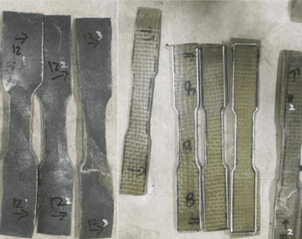
Glass fiber reinforced polymer (GFRP) laminates fabricated by hand lay-up are prone to interlaminar defects such as voids and blisters because compaction pressure, resin distribution, and ply alignment depend on operator skill rather than controlled process parameters. This study characterizes the tensile response of hand lay-up chopped-strand-mat/woven-roving (CSM-WR) GFRP laminates with 8, 10, and 12 reinforcement layers, each containing an intentionally introduced interlaminar defect, and compares the results with the minimum tensile strength required by the Indonesian Classification Bureau (BKI) and with published data for related laminate systems. Three specimens were tested per configuration using ISO 527-4 tensile coupons at a crosshead speed of 5 mm/min. All nine specimens exceeded the 98 MPa BKI minimum despite the defects. The mean ultimate tensile strength was 137.59 MPa for the 8-layer group, 118.20 MPa for the 10-layer group, and 137.09 MPa for the 12-layer group, showing that tensile strength did not increase monotonically with layer count, a trend also observed in published hybrid-fiber laminates with the same layer counts. The 12-layer group, which carried a blister-type defect, had a mean tensile strength about 7% below a published defect-free 12-layer CSM-WR benchmark and the highest coefficient of variation (17.72%) among the three configurations, consistent with compaction pressure being a dominant source of scatter in hand lay-up GFRP. These findings indicate that localized void- and blister-type defects of the size introduced here do not necessarily disqualify hand lay-up CSM-WR panels from meeting BKI tensile strength requirements, though closer control of compaction during lay-up of thicker laminates is warranted.
References
[1] F. Rubino, A. Nistico, F. Tucci, and P. Carlone, "Marine application of fiber reinforced composites: A review," Journal of Marine Science and Engineering, vol. 8, no. 1, art. 26, 2020, doi: 10.3390/jmse8010026.
[2] L. Wijewickrama, J. Jeewantha, G. I. P. Perera, O. Alajarmeh, and J. Epaarachchi, "Fiber-reinforced composites used in the manufacture of marine decks: A review," Polymers, vol. 17, no. 17, art. 2345, 2025, doi: 10.3390/polym17172345.
[3] A. Dinita et al., "Advancements in fiber-reinforced polymer composites: A comprehensive analysis," Polymers, vol. 16, no. 1, art. 2, 2024, doi: 10.3390/polym16010002.
[4] S. Mahboubizadeh, A. Sadeq, Z. Arzaqi, O. Ashkani, and M. Samadoghli, "Advancements in fiber-reinforced polymer (FRP) composites: An extensive review," Discover Materials, vol. 4, no. 1, 2024, doi: 10.1007/s43939-024-00091-9.
[5] A. Ismail, B. Ma'ruf, A. Zubaydi, M. A. D. Octavanny, and T. L. Ginta, "Strength assessment of fiberglass layer configurations in FRP ship materials from yard practices using a statistical approach," Curved and Layered Structures, vol. 11, no. 1, 2024, doi: 10.1515/cls-2024-0007.
[6] R. Ruzuqi, “Tensile strength analysis of polymer composite materials fiber reinforced in the fiberboat application,” Journal of Research and Opinion, vol. 7, no. 8, pp. 2763–2769, 2020, doi: 10.15520/jro.v7i8.74.
[7] B. Ma'ruf, A. Ismail, D. P. Sari, and S. H. Sujiatanti, "Strength analysis of marine biaxial warp-knitted glass fabrics as composite laminations for ship material," Curved and Layered Structures, vol. 10, no. 1, 2023, doi: 10.1515/cls-2022-0209.
[8] A. F. Zakki and A. Windyandari, "Simplified FE model and experimental study on the tensile properties of the glass fiber reinforced polyester polymer," Heliyon, vol. 8, no. 10, art. e10999, 2022, doi: 10.1016/j.heliyon.2022.e10999.
[9] R. Ramli, A. Alisibramulisi, S. M. Noor, and D. D. Suharso, "Analysis of tensile strength on various layer stack sequence of fiber reinforced polymer (FRP)," Journal of Sustainable Civil Engineering and Technology, vol. 1, no. 1, pp. 50-60, 2022, doi: 10.24191/jscet.v1i1.50-60.
[10] I. Milosan, T. Bedo, C. Gabor, and M. A. Pop, "Mechanical characteristics of glass-fiber-reinforced polyester composite materials," Materials, vol. 18, no. 15, art. 3595, 2025, doi: 10.3390/ma18153595.
[11] M. D. Stanciu, H. T. Draghicescu, and I. C. Rosca, "Mechanical properties of GFRPs exposed to tensile, compression and tensile-tensile cyclic tests," Polymers, vol. 13, no. 6, art. 898, 2021, doi: 10.3390/polym13060898.
[12] C. O. Ndukwe, B. O. Ezurike, and P. C. Okpala, "Comparative studies of experimental and numerical evaluation of tensile properties of glass fibre reinforced polyester (GFRP) matrix," Heliyon, vol. 7, no. 5, art. e06887, 2021, doi: 10.1016/j.heliyon.2021.e06887.
[13] A. B. Sulistyo and W. A. Wirawan, "Evaluation of tensile strength and flexural strength of GFRP composites in different types of matrix polymers," Journal of Achievements in Materials and Manufacturing Engineering, vol. 123, no. 1, 2024, doi: 10.5604/01.3001.0054.6847.
[14] G. S. C. Assuncao, J. A. Velasques, A. Zakrzevski, and I. de Costa, "Mechanical properties of glass-fiber reinforced polyester composites manufactured by two different spray-up techniques," Materia (Rio de Janeiro), vol. 29, no. 3, 2024, doi: 10.1590/1517-7076-RMAT-2024-0450.
[15] A. Talabari, M. Alaei, and H. Shalian, "Experimental investigation of tensile properties in a glass/epoxy sample manufactured by vacuum infusion, vacuum bag and hand layup process," Revue des Composites et des Materiaux Avances, vol. 29, no. 3, pp. 179-182, 2019, doi: 10.18280/rcma.290308.
[16] A. Hindersmann, "Confusion about infusion: An overview of infusion processes," Composites Part A: Applied Science and Manufacturing, vol. 126, art. 105583, 2019, doi: 10.1016/j.compositesa.2019.105583.
[17] S. van Oosterom, T. Allen, M. Battley, and S. Bickerton, "An objective comparison of common vacuum assisted resin infusion processes," Composites Part A: Applied Science and Manufacturing, vol. 125, art. 105528, 2019, doi: 10.1016/j.compositesa.2019.105528.
[18] T. I. Altanopoulos and I. G. Raftoyiannis, "Deriving tensile properties of glass fiber reinforced polymers (GFRP) using mechanics of composite materials," Open Journal of Composite Materials, vol. 10, no. 1, pp. 1-14, 2020, doi: 10.4236/ojcm.2020.101001.
[19] A. Jafari et al., "Effect of fibers configuration and thickness on tensile behavior of GFRP laminates subjected to elevated temperatures," Construction and Building Materials, vol. 202, pp. 189-207, 2019, doi: 10.1016/j.conbuildmat.2019.01.003.
[20] M. Bazli, H. Ashrafi, A. Jafari, X.-L. Zhao, R. K. S. Raman, and Y. Bai, "Effect of fibers configuration and thickness on tensile behavior of GFRP laminates exposed to harsh environment," Polymers, vol. 11, no. 9, art. 1401, 2019, doi: 10.3390/polym11091401.
[21] V. Modi, K. K. Singh, and R. Shrivastava, "Effect of stacking sequence on interlaminar shear strength of multidirectional GFRP laminates," Materials Today: Proceedings, vol. 22, pp. 2207-2214, 2020, doi: 10.1016/j.matpr.2020.03.301.
[22] M. Mehdikhani, L. Gorbatikh, I. Verpoest, and S. V. Lomov, "Voids in fiber-reinforced polymer composites: A review on their formation, characteristics, and effects on mechanical performance," Journal of Composite Materials, vol. 53, no. 12, pp. 1579-1669, 2019, doi: 10.1177/0021998318772152.
[23] Y. Fu and X. Yao, "A review on manufacturing defects and their detection of fiber reinforced resin matrix composites," Composites Part C: Open Access, vol. 8, art. 100276, 2022, doi: 10.1016/j.jcomc.2022.100276.
[24] M. Elkolali, L. P. Nogueira, P. O. Ronning, and A. Alcocer, "Void content determination of carbon fiber reinforced polymers: A comparison between destructive and non-destructive methods," Polymers, vol. 14, no. 6, art. 1212, 2022, doi: 10.3390/polym14061212.
[25] X. Lu et al., "Accurate detection of porosity in glass fiber reinforced polymers by terahertz spectroscopy," Composites Part B: Engineering, vol. 242, art. 110058, 2022, doi: 10.1016/j.compositesb.2022.110058.
[26] W. Harizi, S. Chaki, G. Bourse, and M. Ourak, "Damage mechanisms assessment of glass fiber-reinforced polymer (GFRP) composites using multivariable analysis methods applied to acoustic emission data," Composite Structures, vol. 289, art. 115470, 2022, doi: 10.1016/j.compstruct.2022.115470.
[27] J. Jang, M. Maydison, Y. Kim, Z. Han, and D. Oh, "Effect of void content on the mechanical properties of GFRP for ship design," Journal of Marine Science and Engineering, vol. 11, no. 6, art. 1251, 2023, doi: 10.3390/jmse11061251.
[28] A. A. Abd-Elhady, A. Meroufel, H. E.-D. M. Sallam, and M. Atta, "Experimental and numerical determination of critical osmotic blister size affecting the strength of aged FRP seawater pipe," Polymers and Polymer Composites, vol. 29, no. 5, pp. 456-469, 2021, doi: 10.1177/0967391120922397.
[29] M. O. Ayanoglu, L. A. Carlsson, and E. Du, "Effects of void content on the moisture uptake and mechanical strength of a glass/epoxy composite," Journal of Composite Materials, vol. 57, no. 2, pp. 325-336, 2023, doi: 10.1177/00219983221144500.
[30] X. Yang, Y. Fang, R. Wang, Y. Li, and Z. Chen, "Visual quantitative detection of delamination defects in GFRP via microwave," Sensors, vol. 23, no. 14, art. 6386, 2023, doi: 10.3390/s23146386.
[31] Y. Zhang, Y. Li, X. Luan, B. Meng, J. Liu, and Y. Lu, "Effects of void characteristics on the mechanical properties of carbon fiber reinforced polyetheretherketone composites: Micromechanical modeling and analysis," Polymers, vol. 17, no. 13, art. 1721, 2025, doi: 10.3390/polym17131721.
[32] Y. K. Beng, M. N. Dalimin, and M. A. Faizal, "Mode-I toughness and curing pressure characteristic of symmetrical lay-up of plain-weave woven GFRP composites," Journal of Applied Sciences, vol. 7, no. 15, pp. 2174-2182, 2007, doi: 10.3923/jas.2007.2174.2182.
[33] T. S. Dawood, B. M. Fadhil, and D. O. Ramadan, "Effect of adding SiO2 nanoparticles on tensile and bending tests of glass/carbon hybrid composite materials," Journal of Jilin University (Engineering and Technology Edition), vol. 41, no. 11, pp. 55-68, 2022, doi:10.17605/OSF.IO/VCX68.
[34] T. W. Pribadi and R. C. Ariesta, "Study on Fiberglass Boat Strength and Durability under Different Types of Damage," in 2025 IEEE Ocean Engineering Technology and Innovation Conference: Management and Conservation for Sustainable and Resilient Marine and Coastal Resources (OETIC), Surabaya, Indonesia, 2025, pp. 163-169, doi: 10.1109/OETIC67587.2025.11512877.
[35] Biro Klasifikasi Indonesia, "Rules for Classification and Construction, Part 1 Seagoing Ships: Rules for Non-Metallic Materials," Jakarta, Indonesia, 2025.
[36] International Organization for Standardization, "ISO 527-1:2019, Plastics—Determination of tensile properties—Part 1: General principles," Geneva, Switzerland, 2019.
[37] International Organization for Standardization, "ISO 527-4:2021, Plastics—Determination of tensile properties—Part 4: Test conditions for isotropic and orthotropic fibre-reinforced plastic composites," Geneva, Switzerland, 2021.
[38] Standard Test Method for Tensile Properties of Plastics, ASTM D638-22, ASTM International, West Conshohocken, PA, USA, 2022, doi: 10.1520/D0638-22.
[39] M. M. Hiremath, T. Bernthaler, P. Anger, S. K. Mishra, A. Guha, And A. Tewari, “Comparison Of Damage Mechanisms In Chopped Strand Mat And Woven Roving Mat Composites Under Cyclic Tension,” Polymer Composites, Vol. 45, No. 12, Pp. 11162–11177, 2024, Doi: 10.1002/Pc.28539.
[40] R. Muharom, Alamsyah, T. Hidayat, and H. Syahab, "The Influence of Fiberglass Fiber Arrangement Variations on the Tensile and Bending Strength of Ships," Indonesian Journal of Maritime Technology, vol. 2, no. 2, pp. 57–67, 2024, doi: 10.35718/ismatech.v2i2.1203.
[41] M. U. Pawara et al., “Assessment of coconut petiole fiber-reinforced hybrid composites as sustainable materials for ship components,” Indonesian Journal of Maritime Technology, vol. 3, no. 2, pp. 142–149, 2025, doi: 10.35718/ismatech.v3i2.8481890.
Downloads
Published
How to Cite
Issue
Section
License
Copyright (c) 2026 Restu muharom, Achmad Zubaydi, Mohammad Nurul Misbah, Rizky Chandra Ariesta, Dzaky Hanif Arjuna

This work is licensed under a Creative Commons Attribution-ShareAlike 4.0 International License.