
Structural Response and Optimization of a Tugboat Midship Section Under Varied Transverse Frame Spacing Using Finite Element Analysis
DOI:
https://doi.org/10.35718/ismatech.v4i1.8482002Keywords:
Tugboat, Von Mises Stress, Midship Section, Frame spacing, DeformationAbstract
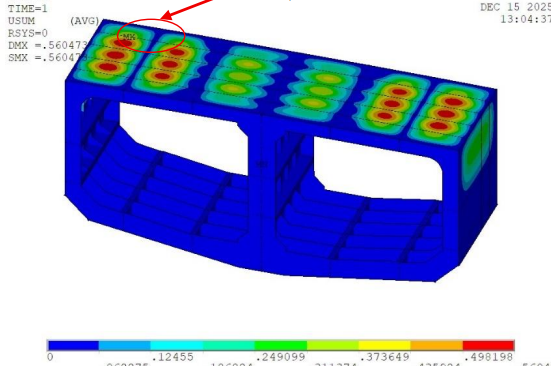
Transverse framing systems serve as a critical structural backbone for marine vessels, governing localized stiffness and cross-sectional hull strength. This study investigates the structural response of a tugboat’s midship section under various transverse frame spacing configurations using the Finite Element Method (FEM) to optimize lightweight tonnage (LWT) while maintaining seaworthiness. Utilizing structural data from a under-30-meter service tugboat, five distinct frame spacing variations 500 mm (baseline actual design), 550 mm, 575 mm, 600 mm, and 625 mm were modeled using four-node shell elements (SHELL181) within ANSYS software. A constant uniform static deck pressure load of 0.0122 MPa was applied to evaluate localized stress distributions and elastic displacement fields under rigid boundary conditions. Numerical simulations reveal a progressive, linear increase in both equivalent stresses and vertical deflections as the unsupported span of the deck plating expands. The maximum von Mises equivalent stress escalated from 31.4237 MPa at the 500 mm baseline configuration to 34.1552 MPa (550 mm), 35.4687 MPa (575 mm), 36.8590 MPa (600 mm), and peaked at 40.6607 MPa under the widest 625 mm spacing. Concurrently, the total displacement vector sum rose from 0.56047 mm at the baseline to a peak of 0.86030 mm at 625 mm spacing due to the reduction of localized flexural rigidity. Crucially, despite the elevated structural responses, all configurations safely satisfy the strict structural limits enforced by the Indonesian Classification Bureau (BKI 2022) rules, as the maximum peak stress (40.6607 MPa) remains substantially below the nominal upper yield strength of ordinary hull structural steel (ReH = 235 N/mm2). These findings demonstrate that extending the transverse frame spacing up to 625 mm is structurally viable, offering a verified mechanism for weight optimization without compromising structural safety margins.
References
[1] J. K. Paik, Ultimate Limit State Design of Steel-Plated Structures. Chichester, UK: Wiley, 2018.
[2] Xiong Y, Li C, Cai S, Wang D. The dynamic ultimate strength of stiffened panels under axial impact loading. Ships and Offshore Structures. 2023 May 4;18(5):707-20. doi; https://doi.org/10. 1080/17445302.2022.2067417
[3] Abedin J. Structural optimisation of ship hull using finite element method (Doctoral dissertation, Newcastle University). doi; http://theses.ncl.ac.uk/jspui/handle/10443/6610
[4] Ma Z, Pei Z, Wu W. Dynamic ultimate strength analysis of stiffened plate based on Idealized Structural Unit Method. Marine Structures. 2022 Jul 1;84:103203. doi; https://doi.org/10.1016/j.marstruc. 2022.103203
[5] Ilić N, Momčilović N. Progressive collapse analysis of inland waterway cargo vessel. Procedia Structural Integrity. 2023 Jan 1;48:318-25. doi; https://doi.org/10.1016/j.prostr.2023.07.126
[6] Biro Klasifikasi Indonesia (BKI), Rules for Hull, Volume II. Jakarta: BKI, 2022.
[7] Yang Y, Mu Z, Zhu B. Numerical Study on Elastic Buckling Behavior of Diagonally Stiffened Steel Plate Walls under Combined Shear and Non-Uniform Compression. Metals. 2022 Mar 31;12(4):600. doi; https://doi.org/10.3390/met12040600
[8] Pawara MU, Alamsyah A, Kusuma IP, Wulandari AI, Ikhwani RJ, Arifuddin MN. A Finite Element Analysis of Bottom Structure of LCT Converted from SPOB. Maritime Park: Journal of Maritime Technology and Society. 2023 Feb 27:8-15. doi: https://doi.org/10.62012/mp.v2i1.25130
[9] A. alamsyah, A. Falevi, A. Wulandari, M. Pawara, W. Setiawan, and A. Arifuddin, “Investigating the Local Stress of Car Deck Ro-Ro 5000 GT”, EPI International Journal of Engineering, vol. 4, no. 1, pp. 51-56, Feb. 2021. doi: https://doi.org/10.25042/epi-ije.022021.08
[10] Barsotti B, Battini C, Gaiotti M, Rizzo CM, Vergassola G. Experimental and numerical assessment of ultimate strength of a transversally loaded thin-walled deck structure. Marine Structures. 2025 Aug 15;103:103793. doi; https://doi.org/10.1016/j.marstruc.2025.103793
[11] K. Suzuki, "Safety margins and yielding criteria of service vessels based on classification rules," Journal of Marine Science and Engineering, vol. 9, no. 4, p. 412, 2021.
[12] A. M. N. Arifuddin, “Effect of Lifting Lug Hole Diameter Size on Strength Performance in Ship Block Lifting Process: English”, ISMATECH, vol. 3, no. 1, Apr. 2025. doi: https://doi.org/10.35718/ismatech.v3i1.8481345
[13] A. I. Wulandari, R. J. Ikhwani, S. s. suardi, R. S. Yani, A. N. Himaya, and a. alamsyah, "Collision Analysis Of A Self Propelled Oil Barge (SPOB) Using Finite Element Method," Kapal: Jurnal Ilmu Pengetahuan dan Teknologi Kelautan, vol. 19, no. 2, pp. 101-111, Jul. 2022. doi; https://doi.org/10.14710/kapal.v19i2.45417
[14] P. S. Lee and H. C. Noh, "A study on convergence criteria for four-node shell elements in ship midship modeling," International Journal for Numerical Methods in Engineering, vol. 102, no. 8, pp. 1420–1435, 2015.
[15] O. Hughes and J. K. Paik, Ship Structural Analysis and Design. Jersey City, NJ: SNAME, 2010.
[16] A. Alam, A. I. Wulandari, N. S. Oktavaro, M. U. Pawara, and M. Riyadi, “The Fatigue Life Assessment of Sideboard on Deck Barge Using Finite Element Methods”, Majalah Ilmiah Pengkajian Industri, vol. 16, no. 1, pp. 1–10, Sep. 2023. doi: https://doi.org/10.29122/mipi.v16i1.5201
[17] Wang Y. Stochastic Dynamic Response and Stability of Ships and Offshore Platforms. Springer; 2024.
[18] M. U. Pawara, A. Pawara, M. Syarif, F. Mahmuddin, and Harifuddin, “Effect of Post Weld Heat Treatment on Tensile Strength of ASTM A36 Welded Joints: Application on Hull Vessel Material”, IJMEIR, vol. 8, no. 1, pp. 56–65, Jul. 2025. doi: https://doi.org/10.12962/j25481479.v8i1
[19] Georgiadis DG, Samuelides ES, Straub D. A Bayesian analysis for the quantification of strength model uncertainty factor of ship structures in ultimate limit state. Marine Structures. 2023 Nov 1;92:103495. doi; https://doi.org/10.1016/j.marstruc.2023.103495
[20] Wulandari AI, Suardi A, Ciptiandi A. Strength analysis with variation of construction transverse watertight bulkhead on ship container 8842 dwt using finite element method. Int. J. Mar. Eng. Innov. Res. 2023 Jun 16;8. doi: https://doi.org/10.12962/j25481479.v8i2
[21] da Silveira T, Crestani EA, dos Santos ED, Isoldi LA. Numerical Analysis of Aspect Ratio Effects on the Mechanical Behavior of Perforated Steel Plates. Metals. 2025 Jul 11;15(7):786. doi; https://doi.org/10.3390/met15070786
[22] Han P, Pak C, Yun C, Ri K, Choe T. Empirical formulations for estimation of the ultimate strength of the perforated stiffened panels under the combined lateral pressure and in-plane compression. Ocean Engineering. 2022 Dec 15;266:112620. doi; 10.1016/j.oceaneng.2022.112620
[23] Y. N. Ivanov, "Load path redirection in structural optimization of ship hull modules," Marine Engineering Frontiers, vol. 8, no. 2, pp. 88–99, 2021.
[24] S. P. Timoshenko and S. Woinowsky-Krieger, Theory of Plates and Shells. New York, NY: McGraw-Hill, 1959.
[25] K. M. Rahman, "FEA simulation guidelines for structural behavior of tugboat hull panels," Ocean Systems Engineering, vol. 11, no. 3, pp. 245–259, 2021.
[26] M. S. Kim and J. M. Lee, "Weight optimization of small service vessels through framing arrangement modifications and finite element verification," Ocean Engineering, vol. 242, p. 110115, 2022.
Downloads
Published
How to Cite
Issue
Section
License
Copyright (c) 2026 Amalia Ika Wulandari, Alamsyah Alamsyah, Hariyono, Ryan Raruk, Husein Syahab, Muhammad Anjas Syam, Suardi Suardi, Dimas Fajar Prasetyo

This work is licensed under a Creative Commons Attribution-ShareAlike 4.0 International License.