
Resistance Analysis for the Application of Flowbow on DTMB 5415 Ship
DOI:
https://doi.org/10.35718/ismatech.v4i1.8481997Keywords:
bulbous-bow, CFD, Ship Resistance, semi-displacement, flowbowAbstract
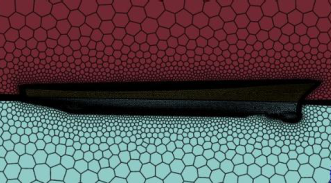
Flowbow is an innovation designed by Rasmussen to increase fuel efficiency by reducing wave making resistance of ship. It is claimed that Flowbow can reduce the resistance of displacement and semi-displacement hull type at Froude number (Fr) over 0.25 to 0.28. On a warship, resistance reduction can increase the patrolling endurance by reducing energy used to moving. This research comparing the hull of DTMB 5415 model, which is already using bulbous bow and the modified DTMB 5415 hull with the addition of Flowbow using CFD which is validated by EFD. The results show that the addition of a Flowbow reduces ship resistance at Fr greater than 0.249 and the resistance reduction increases as the ship speed increases. At the highest tested speed (Fr = 0.352), the total resistance reduction reaches 8.57%.
References
[1] Y. Y. E. Darma, R. A. . Sugiarto, A. F. N. Oloan, and F. Narotama, “CFD-Based Comparative Study of Axe Bow and Bulbous Bow Designs for Corvette Warship Deployment in Natuna Waters”, IJMEIR, vol. 10, no. 3, pp. 827–837, Sep. 2025. doi: https://doi.org/10.12962/j25481479.v10i3
[2] Samuel S., Sam Timoty Frans Evan S., Trimulyono A., Muhammad Iqbal. (2022). An analysis of the effect of the bow entrance angle on ship resistance. doi: http://doi.org/10.22441/sinergi.2022.2.011
[3] Papanikolaou, A. (2014). Ship design: Methodologies of preliminary design. In Ship Design: Methodologies of Preliminary Design. Springer Netherlands. doi: https://doi.org/10.1007/978-94-017-8751-2
[4] Zhang, Y., et al. (2021). CFD-based optimization of bulbous bow for resistance reduction. Ocean Engineering.
[5] Deng, R., Huang, S., Wang, S., Liu, H., Yu, X., & Wu, T. (2023). Experimental study on the influence of a T-foil and bulbous bow on the resistance and motion in regular head waves of trimarans. Ocean Engineering. doi: 10.1016/j.oceaneng.2023.114990
[6] Gaggero, S., et al. (2021). CFD prediction of ship resistance and propulsion performance. Applied Ocean Research.
[7] Flowbow. (2023). Flowbow. Retrieved May 24, 2024, from https://www.flowbow.no/
[8] M. G. Hutabarat, S. Samuel, and A. Trimulyono, "Analisis pengaruh variasi bentuk haluan dan buritan terhadap hambatan pada kapal US Navy Combatant DTMB Model 5415 dengan metode CFD [Analysis of the influence of variations in the shape of the bow and stern on the resistance of the US Navy Combatant DTMB Model 5415 ship using the CFD method] ," Jurnal Teknik Perkapalan, vol. 12, no. 2, Jun. 2024. [Online]. Retrieved from : https://ejournal3.undip.ac.id/index.php/naval/article/view/44992/0
[9] Suastika, K. (2023). Dinamika Fluida Komputasi. itspress.
[10] Menter F R. (1994). Two-equation eddy-viscosity turbulence models for engineering applications AIAA Journal 32 1598–605
[11] Putra, Z. T. S. (2020). Analisis Hambatan Pada Kapal Katamaran Dengan Transverse Stepped Hull Dengan Metode Computational Fluid Dynamics [Resistance Analysis on Catamaran Ships with Transverse Stepped Hull Using Computational Fluid Dynamics Method]. http://repository.its.ac.id/id/eprint/80253
[12] ITTC. (2011). Practical Guidelines for Ship CFD Applications.
[13] Versteeg, H. K., & Malalasekera, W. (2007). An introduction to computational fluid dynamics: The finite volume method (2nd ed.). Pearson Education.
[14] Regitasyali, S., Aliffrananda, M. H. N., Hermawan, Y. A., Hakim, M. L., & Utama, I. K. A. P. (2022). Numerical investigation on the effect of homogenous roughness due to biofouling on ship friction resistance. IOP Conference Series: Earth and Environmental Science, 972(1). doi: https://doi.org/10.1088/1755-1315/972/1/012026
[15] Dewantara, D. R., & Utama, I. K. A. P. (2025). The Performance of Wing-In-Ground Craft with Anhedral and Rear Planform Cropping Wing Configurations.
[16] Celik I B, Ghia U, Roache P J, Freitas C J, Coleman H and Raad P E. (2008). Procedure for Estimation and Reportingof Uncertainty Due to Discretization in CFD Applications J. Fluids Eng. 130 078001
[17] Suryawan, D., Suastika, I. K., & Ali, B. (2025). Comparative study of ship resistance calculated from CFD and obtained from towing tests: Case study of LCT vessel. IOP Conference Series: Earth and Environmental Science, 1461(1). doi: https://doi.org/10.1088/1755-1315/1461/1/012006
[18] Yasin Öztürk, M., & Çoşgun, T. (2024). Impact of Bulbous Bow Geometry on Ship Resistance: A Numerical Study. In International Journal of Advanced Natural Sciences and Engineering Researches (Vol. 11, Issue 11). doi; https://as-proceeding.com/index.php/ijanser
Downloads
Published
How to Cite
Issue
Section
License
Copyright (c) 2026 Arga Setya Andreardani, I Ketut Suastika, Baharuddin Ali, Taufiq Arif Setyanto, Mahendra Indiaryanto, Amalia Ika Wulandari, Anson Novendra Pradana

This work is licensed under a Creative Commons Attribution-ShareAlike 4.0 International License.