Energy Efficiency Analysis of Main Cooling Pump System on Bulk Carrier Using VSD
DOI:
https://doi.org/10.35718/ismatech.v4i1.8481980Keywords:
Energy Efficiency, Cooling System, Variable Speed Drive, Pump Performance, Bulk CarrierAbstract
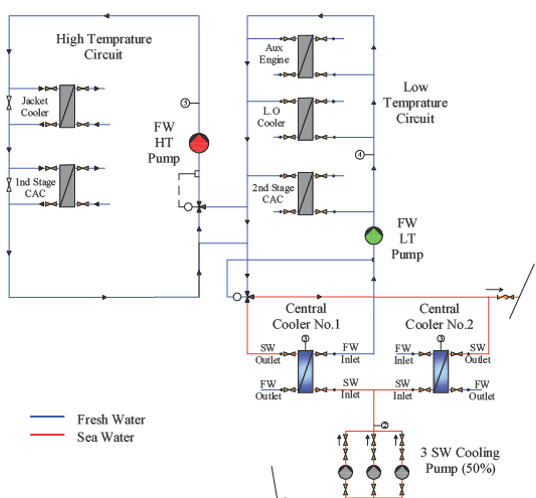
Improving energy efficiency in marine auxiliary systems has become increasingly important due to rising fuel consumption, stricter environmental regulations, and global green shipping initiatives. Conventional seawater cooling pumps on bulk carrier vessels generally operate at constant speed regardless of cooling demand, resulting in excessive energy consumption under partial-load conditions. Previous studies mainly focused on general Variable Speed Drive (VSD) applications, while limited research investigated the integrated performance of seawater cooling systems in bulk carriers, particularly the relationship between pump energy consumption, heat transfer performance, and operational efficiency. This study was conducted to evaluate the energy efficiency of the main cooling pump system on a bulk carrier vessel through the implementation of a Variable Speed Drive (VSD). The analysis was conducted using a thermodynamic simulation approach under steady-state conditions by applying pump affinity laws, heat transfer equations, and operational data from a MAN B&W S42MC marine diesel engine under various engine loads and seawater temperatures. The results show that VSD implementation reduced pump power consumption from approximately 26 kW to 2–10 kW under partial-load conditions, corresponding to improved pump efficiency, with a maximum efficiency of approximately 82% achieved near the Best Efficiency Point (BEP). The cooling system also maintained stable freshwater outlet temperatures around 36°C, indicating effective heat transfer performance, thermal stability, and improved cooling system energy efficiency. These findings confirm that VSD operation is highly effective under partial-load conditions and supports ship energy management systems to reduce fuel consumption and support sustainable green shipping practices.
References
[1] Yoz Gunawan, “Analisis Peningkatan Temperatur Air Pendingin Mesin Induk Di Mt. Queen Majesty Skripsi,” pp. 1–37, 2024.
[2] Z. Tian, Z. Qi, W. Gan, M. Tian, and W. Gao, “A novel negative carbon-emission, cooling, and power generation system based on combined LNG regasification and waste heat recovery: Energy, exergy, economic, environmental (4E) evaluations,” Energy, vol. 257, p. 124528, 2022, doi: 10.1016/j.energy.2022.124528.
[3] T. Zhou, Q. Hu, Z. Hu, and J. Zhi, “Theory and Application of Vessel Speed Dynamic Control considering Safety and Environmental Factors,” J. Adv. Transp., vol. 2022, 2022, doi: 10.1155/2022/5333171.
[4] Suardi, “Performance and Emission Characteristics of Diesel Engines Using Biodiesel from Waste Cooking Oil with Cetane Number Improver”, IJMEIR, vol. 9, no. 3, pp. 528–536, Jul. 2025. https://doi.org/10.12962/j25481479.v9i3
[5] Suardi, Suardi; Ikhwani, Rodlian Jamal; and Aulia, Ade Putri Rezki (2023) "Effect of Temperature Variations of Corn (Maize) Oil Biodiesel on Torque Values and Thermal Efficiency of Diesel Engines," Journal of Mechanical Engineering Science and Technology (JMEST): Vol. 7: No. 1, Article 10.
doi: 10.17977/um016v7i12023p087
[6] Ö. B. İNAL and G. KOÇAK, “A Case Study on the Variable Frequency Drive for Ship Engine Room Ventilation,” Mar. Sci. Technol. Bull., vol. 12, no. 3, pp. 252–258, Sep. 2023, doi: 10.33714/masteb.1299692.
[7] J. Wang, F. Zhao, L. Sun, Y. Hou, and N. Chen, “Research on the Energy Savings of Ships’ Water Cooling Pump Motors Based on Direct Torque Control,” Processes, vol. 11, no. 7, Jul. 2023, doi: 10.3390/pr11071938.
[8] M. A. Motamed and L. O. Nord, “Part-load efficiency boost in offshore organic Rankine cycles with a cooling water flow rate control strategy,” Energy, vol. 257, p. 124713, 2022, doi: 10.1016/j.energy.2022.124713.
[9] A. Rahman, Antariksa, B. Semedi, and S. Wahyudi, “Implementation of fully electric propulsion and variable speed drive to reduce ships emissions for sustainable maritime technology,” Edelweiss Applied Science and Technology, vol. 9, no. 2, pp. 871–887, 2025, doi: 10.55214/25768484.v9i2.4623.
[10] Y. Liu, Z. Zhuang, Y. Zhou, S. Zhao, D. Wang, and H. Liu, “Heat transfer performance analysis of seawater heat exchange pipelines in deep seawater closed cooling air conditioning system,” Appl. Therm. Eng., vol. 212, no. 13, p. 118582, 2022, doi: 10.1016/j.applthermaleng.2022.118582.
[11] A. Sardar, R. Islam, M. Anantharaman, and V. Garaniya, “Advancements and obstacles in improving the energy efficiency of maritime vessels: A systematic review,” May 01, 2025, Elsevier Ltd. doi: 10.1016/j.marpolbul.2025.117688.
[12] J. D. Hunt et al., “Deep seawater cooling and desalination: Combining seawater air conditioning and desalination,” Sustain. Cities Soc., vol. 74, no. May, 2021, doi: 10.1016/j.scs.2021.103257.
[13] G. Theotokatos, K. Sfakianakis, and D. Vassalos, “Investigation of ship cooling system operation for improving energy efficiency.”
[14] W. Wibowo et al., “Optimization of main engine cooling system maintenance for mitsubishi 6UEC52LS on MT. Princess Naomi Optimization Of Main Engine Cooling System Maintenance For Mitsubishi 6uec52ls On Mt. Princess Naomi,” Jurnal Teknik Mesin, vol. 11, no. 1, pp. 8–15, 2025.
[15] C. M. Lee, T. Y. Jeon, B. G. Jung, and Y. C. Lee, “Design of energy saving controllers for central cooling water systems,” J. Mar. Sci. Eng., vol. 9, no. 5, May 2021, doi: 10.3390/jmse9050513.
[16] T. Y. Jeon and Y. C. Lee, “Energy Saving in Ship Central Cooling Systems: IMC-Tuned PID with Feedforward Control,” J. Mar. Sci. Eng., vol. 13, no. 3, Mar. 2025, doi: 10.3390/jmse13030510.
[17] A. J. G. Yunus A. Cengel, Heat and Mass Transfer: Fundamentals and Applications. 2023.
[18] X. Wu, P. Zhang, P. Su, and J. Wu, “Modeling and Key Parameter Interaction Analysis for Ship Central Cooling Systems,” Applied Sciences (Switzerland), vol. 15, no. 13, Jul. 2025, doi: 10.3390/app15137241.
[19] S. Siswandi et al., “Modeling of Variable Speed Drive in the Control System Laboratory at the Electrical Department of State Polytechnic of Sriwijaya,” 2022.
[20] Eric Kiruja Riungu and Moses Peter Musau, “Economic Analysis and Energy Savings of Variable Speed Drives in Fans Application — A Case Study Capwell Milling Factory,” 2022.
[21] H. Ye et al., “Variable-speed Pumped Hydro Storage Technology: Overview, Solutions and Case Studies.”
[22] R. K. McGovern, 14 : Pumps. 2011. doi: 10.1016/B978-0-12-387693-5.00014-0.
Downloads
Published
How to Cite
Issue
Section
License
Copyright (c) 2026 Fajri Ashfi Rayhan, Rashieka Alma

This work is licensed under a Creative Commons Attribution-ShareAlike 4.0 International License.