
Development of Practical Wind-Assisted Ship Propulsion (WASP) Calculation for Fuel Consumption and Emission Reduction
DOI:
https://doi.org/10.35718/ismatech.v4i1.8481967Keywords:
Wind Assisted Ship Propulsion, Route Optimization, Energy Efficiency, Carbon EmissionsAbstract
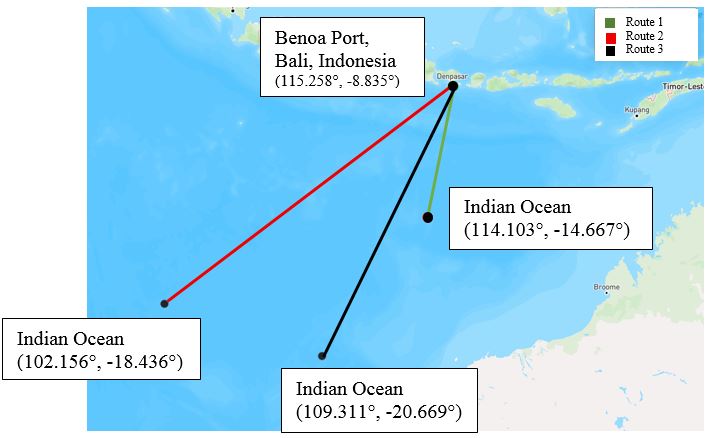
Integration of Wind-Assisted Ship Propulsion (WASP) serves as a strategic solution for the maritime industry to achieve Net Zero Emission by 2050. This research evaluated the interaction between sail design and route optimization for a 265 GT fishing vessel operating around Benoa, Bali to maximize fuel savings and emission reductions. Three hard sail profiles, arc-shaped, NACA 0012, and NACA 0015, were analyzed at operational speeds of 7 and 10 knots. An improved weather-routing framework based on the A* (A-star) algorithm* was developed, integrating weather forecasts, ship specifications, and force matrices to determine optimal navigational paths. Simulations conducted on routes around Benoa, Bali, demonstrated that the combination of aerodynamic wing sails and intelligent routing improved efficiency by 1.24% to 12.59%. The results confirmed that the synergy between WASP technology and precise pathfinding significantly reduced carbon footprints while enhancing the economic viability of shipping operations. These findings provide a scalable framework for sustainable maritime practices and for achieving global decarbonization targets.
References
[1] S. Bali, S. Thangalakshmi, and R. Balaji, "Renewable Energy Options for Seaports," Ocean. Conf. Rec., no. January, 2022, doi: 10.1109/OCEANSChennai45887.2022.9775323.
[2] IMO, "ANNEX 11 MEPC.304(72) - Initial IMO strategy on reduction of GHG emissions from ships," IMO Publ., vol. 304, no. April, pp. 1–11, 2018, [Online]. Available: http://www.imo.org/en/KnowledgeCentre/IndexofIMOResolutions/Marine-Environment-Protection-Committee-%28MEPC%29/Documents/MEPC.304%2872%29.pdf
[3] Suardi, D. Suanggana, and B. Said, “Biodiesel Potentials of Waste Cooking Oil (WCO): Production, Content of Fuel Properties, and Effects on Engine Performance”, IJMEIR, vol. 8, no. 2, pp. 213–221, Jul. 2025. doi: https://doi.org/10.12962/j25481479.v8i2
[4] Suardi, M. Purwanto, A. Y. Kyaw, W. Setiawan, M. U. Pawara, and Alfawan, “Biodiesel Production from POME (Palm Oil Mill Effluent) and Effects on Diesel Engine Perfor-mance”, IJMEIR, vol. 7, no. 4, pp. 292–299, Jul. 2025. doi: https://doi.org/10.12962/j25481479.v7i4
[5] M. D. Hussain, M. S. Tuhin, S. Kabir, and O. M. Amin, "Numerical investigation of the stability and power prediction of a sail based wind propulsion system for a cargo ship," AIP Conf. Proc., vol. 1980, no. July, 2018, doi: 10.1063/1.5044374.
[6] D. Li, Y. Zhang, P. Li, J. Dai, and G. Li, "Aerodynamic performance of a new double-flap wing sail," Polish Marit. Res., vol. 26, no. 4, pp. 61–68, 2019, doi: 10.2478/pomr-2019-0067.
[7] T. P. V. Zis, H. N. Psaraftis, and L. Ding, "Ship weather routing: A taxonomy and survey," Ocean Eng., vol. 213, no. March, p. 107697, 2020, doi: 10.1016/j.oceaneng.2020.107697.
[8] W. Sun, S. Tang, X. Liu, S. Zhou, and J. Wei, "An Improved Ship Weather Routing Framework for CII Reduction Accounting for Wind-Assisted Rotors," J. Mar. Sci. Eng., vol. 10, no. 12, 2022, doi: 10.3390/jmse10121979.
[9] K. Wang et al., "Joint energy consumption optimization method for wing-diesel engine-powered hybrid ships towards a more energy-efficient shipping," Energy, vol. 245, p. 123155, 2022, doi: 10.1016/j.energy.2022.123155.
[10] C. Guzelbulut, T. Badalotti, and K. Suzuki, "Optimization techniques for the design of crescent-shaped hard sails for wind-assisted ship propulsion," Ocean Eng., vol. 312, no. P1, p. 119142, 2024, doi: 10.1016/j.oceaneng.2024.119142.
[11] M. N. Nyanya, H. B. Vu, A. Schönborn, and A. I. Ölçer, "Wind and solar assisted ship propulsion optimisation and its application to a bulk carrier," Sustain. Energy Technol. Assessments, vol. 47, no. September 2020, 2021, doi: 10.1016/j.seta.2021.101397.
[12] I. Göv, M. Hanifi Doğru, İ. Göv, and M. H. Doğru, "Aerodynamic Optimization of Naca 0012 Airfoil," Int. J. Energy Eng. Sci., vol. 2020, no. 2, pp. 146–155, 2020, [Online]. Available: https://www.researchgate.net/publication/374004748
[13] R. R. I., Uddin, Islam, and Rokunuzzaman, "Comparison of Aerodynamics Characteristics of Naca 0015 & Naca 4415 Aerofoil Blade," Int. J. Res. -GRANTHAALAYAH, vol. 5, no. 11, pp. 187–197, 2017, doi: 10.29121/granthaalayah.v5.i11.2017.2346.
[14] Y. Wang, X. Zhang, S. Lin, Z. Qiang, J. Hao, and Y. Qiu, "Analysis on the Development of Wind-assisted Ship Propulsion Technology and Contribution to Emission Reduction," in IOP Conference Series: Earth and Environmental Science, IOP Publishing Ltd, Jan. 2022. doi: 10.1088/1755-1315/966/1/012012.
[15] American Bureau of Shipping, WIND PROPULSION TECHNOLOGIES. 2025.
[16] J. Mason, A. Larkin, S. Bullock, N. van der Kolk, and J. F. Broderick, "Quantifying voyage optimisation with wind propulsion for short-term CO2 mitigation in shipping," Ocean Eng., vol. 289, no. November, 2023, doi: 10.1016/j.oceaneng.2023.116065.
[17] M. Il Roh, "Determination of an economical shipping route considering the effects of sea state for lower fuel consumption," Int. J. Nav. Archit. Ocean Eng., vol. 5, no. 2, pp. 246–262, 2013, doi: 10.2478/ijnaoe-2013-0130.
[18] R. W. Reynolds, T. M. Smith, C. Liu, D. B. Chelton, K. S. Casey, and M. G. Schlax, "Daily high-resolution-blended analyses for sea surface temperature," J. Clim., vol. 20, no. 22, pp. 5473–5496, 2007, doi: 10.1175/2007JCLI1824.1.
[19] ITTC, "Report of the Wind Powered and Wind Assisted Ships Committee," 2024.
[20] C. T. Riccardo De Lauretis, Leonidas Ntziachristos, "International maritime navigation, international inland navigation, national navigation (shipping), national fishing, military (shipping), and recreational boats," in EMEP/EEA air pollutant emission inventory guidebook 2023, 2023.
[21] R. F. Fadillah and F. A. Ayub, "Estimation of daily CO2 emission generated by container ship classified by ClassNK," IOP Conf. Ser. Earth Environ. Sci., vol. 1454, no. 1, 2025, doi: 10.1088/1755-1315/1454/1/012036.
[22] R. Zhang et al., "Numerical investigation on the effects of heel on the aerodynamic performance of wing sails," Ocean Eng., vol. 305, no. February, p. 117897, 2024, doi: 10.1016/j.oceaneng.2024.117897.
[23] P. Sachs, G., Bussotti, "In: Giannessi, F., Maugeri, A. (eds), Application of Optimal Control Theory to Dynamic Soaring of Seabirds. Variational Analysis and Applications. Nonconvex Optimization and Its Applications, vol 79.," in Variational Analysis and Applications. Nonconve, Springer, 2005. doi: https://doi.org/10.1007/0-387-24276-7_57.
[24] C. Li, H. Wang, and P. Sun, "Study on the Influence of Gradient Wind on the Aerodynamic Characteristics of a Two-Element Wingsail for Ship-Assisted Propulsion," J. Mar. Sci. Eng., vol. 11, no. 1, 2023, doi: 10.3390/jmse11010134.
[25] Y. Li, Y. Zhang, and F. Zhu, "Minimal time route for wind-assisted ships," Mar. Technol. Soc. J., vol. 48, no. 3, pp. 115–124, 2014, doi: 10.4031/MTSJ.48.3.2.
[26] A. M. A. Rufatin, A. Yananto, and W. W. Pandoe, "Jurnal Teknologi Lingkungan Karakteristik Angin Wilayah Pesisir Utara Pulau Jawa Berdasarkan Variabilitas Monsun Wind Characteristics of the North Coastal Region of Java Island According to Monsoon Variability," vol. 25, no. 1, pp. 20–30, 2024, doi: https://doi.org/10.55981/jtl.2024.2039.
[27] M. F. Rahmat et al., "Assessment of Wave Characteristics in National Water Borders for Tactical Vessel Analysis and Maritime Security," vol. 04, no. 01, pp. 14–27, 2026, doi: https://doi.org/10.35718/ismatech.v4i1.8481963.
[28] R. Ma et al., "Evaluation Method for Energy Saving of Sail-Assisted Ship Based on Wind Resource Analysis of Typical Route," J. Mar. Sci. Eng., vol. 11, no. 4, 2023, doi: 10.3390/jmse11040789.
[29] E. Pramudya Imawan Santosa, Mochamad Zaed Yuliadi, Achmad Fajar, Suardi, Yulia Ayu Nastiti and Pranatal, "Ship Design Based on Extreme Waves," vol. 03, no. 01, pp. 60–66, 2025, doi: https://doi.org/10.35718/ismatech.v3i1.1353.
Downloads
Published
How to Cite
Issue
Section
License
Copyright (c) 2026 Isna Aulia Marifa, Dian Purnama Sari, Wiwin Sulistyawati

This work is licensed under a Creative Commons Attribution-ShareAlike 4.0 International License.