Assessment of Wave Characteristics in National Water Borders for Tactical Vessel Analysis and Maritime Security
DOI:
https://doi.org/10.35718/ismatech.v4i1.8481963Keywords:
Seasonal Wave Characteristic, Bathymetry Effect, Significant Wave Height (Hsig), Wave Energy Distribution, Ship DesignAbstract
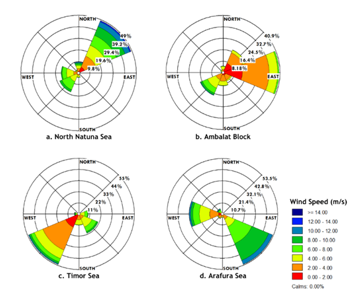
This study addresses the challenge of accurately representing wave conditions in Indonesian waters for ship design, where conventional standards based on North Atlantic extremes may lead to over-conservative designs. The objective is to evaluate seasonal wave characteristics in four representative regions—North Natuna Sea, Ambalat Block, Timor Sea, and Arafura Sea—and assess their implications for ship operational reliability. Hourly wind and wave data for 2025 were obtained from ERA5 reanalysis, while bathymetric information was sourced from BATNAS. Analyses included directional distribution (wind and wave rose), temporal variability of significant wave height (Hsig) and peak period (Tp), wave energy estimation using linear wave theory, and comparison between empirical data and analytical probability models via a Weibull distribution. Results show that the North Natuna Sea experiences the highest wave loading (Hsig up to 4.450 m; energy 13.316 kW/m) due to long fetch and bathymetric shoaling. Ambalat Block exhibits minimal wave energy (0.850 kW/m) despite deep waters, indicating fetch-limited growth. Timor Sea presents moderate Hsig (1.5–2.3 m) with long wave periods (>20 s) driven by swell, while Arafura Sea shows high Hsig (2.663 m) and energy (5.526 kW/m), though shallow-water effects limit wave growth and increase wave steepness. These findings demonstrate that wave loading is controlled not only by height, but also by period and bathymetric transformation. Incorporating site-specific and seasonal wave characteristics is essential for realistic and efficient ship design and operational assessment.
References
[1] J. Matheus, Natashya, A. Gunadi, and S. N. Bunalven, “Ratifikasi Konvensi SUA 1988: Optimalisasi Pengaturan Hukum dalam Memberantas Perampokan Bersenjata di Wilayah Perairan Indonesia,” Jurnal RechtsVinding, vol. 12, no. 3, p. 2023, Dec. 2023, [Online]. Available: https://www.icc-ccs.org/index.
[2] Z. R. M. Zuhdy, “Indonesia’s Response to Sovereignty Threats in the Natuna Sea under UNCLOS 1982,” Port Management and Maritime Administration Journal, vol. 1, no. 2, pp. 18–27, Jul. 2025, [Online]. Available: https://journal.imeral.or.id/index.php/PORTMAN
[3] Lovira, R. A. Putri, R. A. Putra, R. C. V. Siregar, and Z. Hijriyani, “Urgensi Penetapan Garis Pangkal Laut dalam Validasi Hukum Zona Ekonomi Eksklusif Indonesia: Tinjauan Atas Sengketa Maritim,” Journal of Islamic Law El Madani, vol. 4, no. 2, pp. 71–82, Jun. 2025, doi: 10.55438/jile.v4i2.171.
[4] S. Zuhdi, N. F. L. Sari, and L. Sunarti, “Nationalism and Globalization: Issue on the Sea Border Beetwen Indonesia and Australia in the Context of Maritime Sovereignty,” International Review of Humanities Studies, vol. 4, no. 1, pp. 1–13, Jan. 2019.
[5] Huda, A. C., Putri, D., Nurcholik, S. D., & Hasrina. (2024). Tidal Current Pattern Modeling in the Wain River Shipping Channel Waters. Indonesian Journal of Maritime Technology, 2(1). https://doi.org/10.35718/ismatech.v2i1.8481518
[6] S. H. Puna, I. Rahman, and S. L. Sakina, “Studi Karakteristik Gelombang Laut Perairan Indonesia Menggunakan Model Simulating Wave Nearshore (SWAN),” Indonesian Journal of Oceanography, vol. 07, no. 03, pp. 284–297, Aug. 2025, doi: 10.14710/ijoce.v7i3.27227.
[7] A. Ma’rufatin, A. Yananto, and W. W. Pandoe, “Karakteristik Angin Wilayah Pesisir Utara Pulau Jawa Berdasarkan Variabilitas Monsun,” Jurnal Teknologi Lingkungan, vol. 25, no. 1, pp. 20–30, Jan. 2024, [Online]. Available: http://www.meteomanz.com.
[8] I. A. Azies, W. Pranowo, and I. W. S. E. Putra, “Karakteristik Kecepatan Hanyut Gelombang di Teluk Jakarta Tahun 2012-2021,” Jurnal Chart Datum, vol. 9, no. 2, pp. 91–112, 2023.
[9] A. Alamsah, A. Wahjudi, P. J. Moon, N. Hamidi, and D. Widhiyanuriyawan, “Potensi Energi Arus dan Tinggi Gelombang Laut Indonesia Berdasarkan Data Penginderaan Jauh,” Jurnal TECHNO-SOCIO EKONOMIKA, vol. 18, no. 1, pp. 49–59, Apr. 2025, doi: 10.32897/techno.2025.18.1.4087.
[10] P. A. Kresnadana and A. Ansori, “Desain Generator Linier untuk Memanen Energi Gelombang,” Jurnal Teknik Mesin, vol. 11, no. 1, pp. 33–40, 2023.
[11] S. D. Pitaloka and M. N. Misbah, “Studi Pengaruh Variasi Pengelasan Bracket terhadap Fatigue Life Struktur Kapal Patroli Cepat 40M Akibat Beban Gelombang,” Jurnal Teknik ITS, vol. 10, no. 1, pp. 51–57, 2020.
[12] H. Siswanti, M. Musta’in, and Akh. Maulidi, “Analisis Pengaruh Variasi Geometry Bulbous Bow Terhadap Probabilitas Slamming Lambung Kapal Pada Kondisi Gelombang Reguler (Studi Kasus Kapal Kontainer 4180 DWT),” Jurnal INOVTEK POLBENG, vol. 11, no. 1, pp. 1–9, Jun. 2021.
[13] C. J. V. Sitorus et al., “Analisis Dinamika Kapal Ikan Berlambung Katamaran terhadap Fenomena Bottom Slamming dan Deck Wetness,” Jurnal Techno Bahari, vol. 12, no. 1, pp. 57–65, Mar. 2025.
[14] A. Fahim, “Analisis Dampak Getaran pada Struktur dan Performa Kapal Menggunakan Metode Pemantauan berbasis Sensor Mems,” Jurnal Penelitian Ilmiah Multidisipliner, vol. 02, no. 02, pp. 181–188, 2025.
[15] Romadhoni, B. Santoso, K. Anwar, B. Satria, Aprizawati, and Suzdyan, “Analisa Pengaruh Variasi Sudut Bilga Keel Terhadap Gerakan Kapal Cepat Tipe Crew Boat,” Jurnal INOVTEK POLBENG, vol. 15, no. 1, pp. 17–31, Jun. 2025, doi: 10.35314/5tfcnb66.
[16] F. A. Prasetyo, T. Firmandha, A. F. Zakki, M. A. Kurniawan, S. Komariyah, and S. Anggara, “The Effect of Local Environmental Condition on the Ship Construction Design Standard,” 2021, pp. 805–821. doi: 10.1007/978-981-15-4624-2_49.
[17] A. A. H. Amran, S. Burhani, and N. Aulia, “Calculation of Thickness of Midship Construction Plates According to the Ship Classification Board,” Indonesian Journal of Contemporary Multidisciplinary Research, vol. 3, no. 1, pp. 211–222, Jan. 2024, doi: 10.55927/modern.v3i1.8023.
[18] Coastal Hydraulic Laboratory (CHL), “Coastal Engineering Manual, Part I-VI,” Washington, D.C., 2002.
[19] P. J. Webster et al., “Monsoons: Processes, Predictability, and the Prospects for Prediction,” J. Geophys. Res. Oceans, vol. 103, no. C7, pp. 14451–14510, Jun. 1998, doi: 10.1029/97jc02719.
[20] V. F. Diana, I. B. Prasetyawan, and Y. J. Wijaya, “Analisis Perubahan Garis Pantai Menggunakan Digital Shoreline Analysis System (DSAS) di Pesisir Kulon Progo, Daerah Istimewa Yogyakarta,” Indonesian Journal of Oceanography, vol. 7, no. 2, pp. 128–139, May 2025, doi: 10.14710/ijoce.v7i2.26219.
[21] C. A. Siregar, “Pembuatan Alat Konversi Energi Memanfaatkan Gelombang dengan Menggunakan Teknik Kolom Osilasi,” Jurnal Mesil (Mesin, Elektro, Sipil), vol. 1, no. 2, pp. 107–115, Dec. 2020.
[22] I. H. Suherman and P. Raharjo, “Potensi Energi Gelombang Laut di Perairan Mentawai,” Jurnal Geologi Kelautan, vol. 18, no. 2, pp. 97–110, Nov. 2020.
[23] Y. Novita, Y. Nugraha, P. I. Wahyuningrum, T. N. C. Bangun, and D. P. Yuwandana, “Arah Pergerakan Kapal dengan Sudut Kedatangan Gelombang yang Menghasilkan Amplitudo Rolling Minimum,” Jurnal Perikanan dan Kelautan, vol. 14, no. 1, pp. 11–27, Jun. 2024, doi: 10.33512/jpk.v14i1.20219.
[24] G. Besio, L. Mentaschi, and A. Mazzino, “Wave Energy Resource Assessment in the Mediterranean Sea on the Basis of a 35-year Hindcast,” Energy, vol. 94, pp. 50–63, Jan. 2016, doi: 10.1016/j.energy.2015.10.044.
[25] A. H. Izadparast and J. M. Niedzwecki, “Estimating the Potential of Ocean Wave Power Resources,” Ocean Engineering, vol. 38, no. 1, pp. 177–185, Jan. 2011, doi: 10.1016/j.oceaneng.2010.10.010.
[26] J. K. Paik, Ultimate Limit State Analysis and Design of Plated Structures. London: Wiley, 2018. doi: 10.1002/9781119367758.
[27] L. G. Otaya, “Distribusi Probabilitas Weibull dan Aplikasinya (Pada Persoalan Keandalan (Reliability) dan Analisis Rawatan (Mantainability),” Jurnal Manajemen Pendidikan Islam, vol. 4, no. 2, pp. 44–66, Aug. 2016.
[28] Chairunnisa, S. N. Atiah, and R. Wahyuni, “Penentuan Tinggi Gelombang Desain untuk Perencanaan Rubble Mound Breakwater Pelabuhan Belawan,” Jurnal Teknik: Media Pengembangan Ilmu dan Aplikasi Teknik, vol. 18, no. 01, pp. 08–16, Jun. 2019, [Online]. Available: http://creativecommons.org/licenses/by/4.0/
[29] A. Dewi, Purwanto, and D. N. Sugianto, “Analisa Deformasi Gelombang di Pulau Siberut Kabupaten Kepulauan Mentawai Sumatera Barat,” Jurnal Oseanografi, vol. 6, no. 2, pp. 330–340, 2017, [Online]. Available: http://ejournal-s1.undip.ac.id/index.php/jose
[30] K. Amri, D. Tanjung, and J. Sarifah, “Analisa Perencanaan Bangunan Pemecah Gelombang (Breakwater) Pada Pelabuhan Ikan Tanjung Tiram,” Buletin Utama Teknik, vol. 16, no. 3, pp. 171–178, 2021.
[31] T. Al Tanto, S. Husrin, U. J. Wisha, A. Putra, R. K. Putri, and Ilham, “Karakteristik Oseanografi Fisik (Batimetri, Pasang Surut, Gelombang Signifikan dan Arus Laut) Perairan Teluk Bungus,” Jurnal Kelautan: Indonesian Journal of Marine Science and Technology, vol. 9, no. 2, pp. 108–121, Oct. 2016, doi: 10.21107/jk.v9i2.1240.
[32] A. M. Lubis, N. Sari, R. Saputra, J. Sinaga, M. Hasanudin, and E. Kusmanto, “Studi Morfologi Dasar Laut dengan Survey Batimetri di Daerah Pantai Pasar Palik, Bengkulu Utara,” Buletin Oseanografi Marina, vol. 10, no. 1, pp. 1–12, Feb. 2021, doi: 10.14710/buloma.v10i1.32691.
[33] H. Hermansyah, D. Nugroho, A. S. Atmadipoera, T. Prartono, I. Jaya, and F. Syamsudin, “Disipasi Energi Kinetik Pasang Surut Barotropik dan Baroklinik di Laut Sulawesi,” Jurnal Ilmu dan Teknologi Kelautan Tropis, vol. 10, no. 2, pp. 365–380, Aug. 2018, doi: 10.29244/jitkt.v10i2.21793.
[34] A. Rojali and J. E. Nandiasa, “Analisis Kondisi Gelombang di Sekitar Pulau Tarakan,” Rekayasa Sipil, vol. 5, no. 1, pp. 24–28, Feb. 2016.
[35] Purwanto et al., “Seasonal Variability of Waves Within the Indonesian Seas and Its Relation With the Monsoon Wind,” Ilmu Kelaut., vol. 26, no. 3, pp. 189–196, Sep. 2021, doi: 10.14710/ik.ijms.26.3.189-196.
[36] K. I. Suniada and E. Susilo, “Keterkaitan Kondisi Oseanografi dengan Perikanan Pelagis di Perairan Selat Bali,” Jurnal Penelitian Perikanan Indonesia, vol. 23, no. 4, pp. 275–286, Dec. 2017, [Online]. Available: http://ejournal-balitbang.kkp.go.id/index.php/jppi
[37] C. Mulyabakti, Moh. I. Jasin, and J. D. Mamoto, “Analisis Karakteristik Gelombang dan Pasang Surut pada Daerah Pantai Paal Kecamatan Likupang Timur Kabupaten Minahasa Utara,” Jurnal Sipil Statik, vol. 4, no. 9, pp. 585–594, Sep. 2016, [Online]. Available: http://eprints.undip.ac.id/
[38] M. P. Suhana, I. W. Nurjaya, and N. M. N. Natih, “Karakteristik Gelombang Laut Pantai Timur Pulau Bintan Provinsi Kepulauan Riau Tahun 2005-2014,” Dinamika Maritim, vol. 6, no. 2, pp. 16–19, Feb. 2018.
[39] K. Ondara, U. J. Wisha, and G. A. Rahmawan, “Karakteristik Hidrodinamika di Perairan Teluk Ambon untuk Mendukung Wisata Selam,” Jurnal Kelautan: Indonesian Journal of Marine Science and Technology, vol. 10, no. 1, pp. 67–77, Apr. 2017, doi: 10.21107/jk.v10i1.2170.
[40] M. F. Rahmat, Suntoyo, and W. A. Pratikto, “Numerical Simulation of Hydrodynamic and Sediment Transport in the Madura Strait,” International Journal of Marine Engineering Innovation and Research, vol. 10, no. 4, pp. 1258–1268, Dec. 2025, https://doi.org/10.12962/j25481479.v10i4.
[41] R. Adriat, Muhardi, Risko, and M. F. Rahmat, “Karakteristik Gelombang Laut di Perairan Pantai Samudera Indah Kabupaten Bengkayang Kalimantan Barat,” MANFISH JOURNAL, vol. 5, no. 1, pp. 32–37, May 2024, doi: 10.31573/manfish.v5i1.725.
[42] A. H. Fajar, D. Chrismianto, and E. S. Hadi, “Studi Analisa Slamming & Deck Wetness Akibat Gerakan Heaving-Pitching Coupling & Gerakan Non-Linier Rolling (Studi Kasus Kapal MT. Pandan),” Jurnal Teknik Perkapalan, vol. 5, no. 4, pp. 677–687, Oct. 2017, [Online]. Available: http://ejournal3.undip.ac.id/index.php/naval
[43] F. Suciaty, “Transformasi Gelombang Swell dan Gelombang Angin di Perairan Selatan Bali,” Reka Racana, vol. 4, no. 3, pp. 28–39, Sep. 2018.
[44] F. W. Wijaya, A. Yunianta, and A. Huddiankuwera, “Pemodelan Transformasi Gelombang Kawasan Kecil Pantai Cemara Nabire,” in Seminar Nasional Teknik Sipil (SNTS) Tahun 2025: Penggunaan Teknologi dan Inovasi dalam Rangka Efisiensi Anggaran pada Pembangunan Infrastruktur, Jayapura: Program Studi Teknik Sipil, Fakultas Teknik, Universitas Yapis Papua (UNIYAP), May 2025, pp. 276–283.
Downloads
Published
How to Cite
Issue
Section
License
Copyright (c) 2026 Muhammad Farhan Rahmat, Husein Syahab, Amalia Ika Wulandari, Cahya Kusuma, Mahendra Indiaryanto, Muhammad Anjas Syam, Fernanda Wahyu Pratama, Firman Noor

This work is licensed under a Creative Commons Attribution-ShareAlike 4.0 International License.