
Computational Fluid Dynamics Analysis of Breakwater Configurations for Enhanced Coastal Resilience in North Java
DOI:
https://doi.org/10.35718/ismatech.v4i1.8481960Keywords:
Breakwater, CFD, Coastal Protection, Wave Attenuation, North JavaAbstract
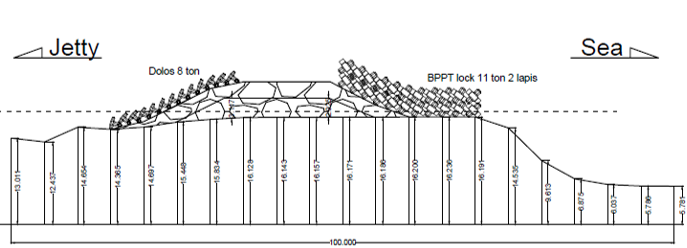
The North Java shoreline, much like coastlines elsewhere in the world, continues to suffer the cumulative effects of coastal erosion and storm surge, and breakwaters remain the principal line of defense against this incoming wave energy. A substantial number of these structures, however, are still sized and shaped using generic rules of thumb instead of being calibrated to site-specific wave conditions and seabed characteristics, and the body of published work that tests breakwater configurations against actual North Java conditions is still limited. The present study closes part of that gap by applying a Computational Fluid Dynamics (CFD) simulation framework to examine how breakwater geometry, porosity, and layout govern hydrodynamic behavior under representative wave loading. The free surface and the wave-structure interaction were resolved using the Volume of Fluid (VOF) approach, paired with a turbulence closure model appropriate for free-surface flow. Over the course of the simulated runs, the configurations under investigation brought wave height down from 1.25 m to roughly 0.45 m by t = 20 s. The seaward face experienced its largest dynamic pressure, 38.7 kPa, at t = 10 s, a moment that also coincided with the highest overtopping velocity of 3.42 m/s, even as flow inside the sheltered zone fell to only 0.22 m/s, a rate low enough to let sediment settle out. A subsequent sensitivity analysis showed that raising porosity by 10% together with a gentler slope gradient lowered the peak structural pressure by as much as 15%, yielding design guidance with practical relevance for North Java and comparable coastal settings
References
[1] H. S. Kim, B. W. Kim, K. Lee, and H. G. Sung, “Application of average sea-state method for fast estimation of fatigue damage of offshore structure in waves with various distribution types of occurrence probability,” Ocean Engineering, vol. 246, Feb. 2022, doi: 10.1016/j.oceaneng.2022.110601.
[2] I. P. S. Asmara, Sumardiono, B. D. Alfanda, K. Abdullah, and A. N. Rochmad, “Study of Offshore Patrol Vessel Models for Seakeeping and Maneuvering Improvement using Anti-Rolling Fins,” in IOP Conference Series: Earth and Environmental Science, IOP Publishing Ltd, Feb. 2022. doi: 10.1088/1755-1315/972/1/012012.
[3] A. Askarian Khoob and M. J. Ketabdari, “A numerical investigation into the effects of long-term wave-induced loads on the cross structure of a wave-piercing trimaran,” Cogent Eng., vol. 4, no. 1, Jan. 2017, doi: 10.1080/23311916.2017.1387951.
[4] A. Gomes, J. L. S. Pinho, T. Valente, J. S. A. do Carmo, and A. V. Hegde, “Performance assessment of a semi-circular breakwater through CFD modelling,” J. Mar. Sci. Eng., vol. 8, no. 3, Mar. 2020, doi: 10.3390/jmse8030226.
[5] F. Dentale, F. Reale, A. Di Leo, and E. P. Carratelli, “A CFD approach to rubble mound breakwater design,” International Journal of Naval Architecture and Ocean Engineering, vol. 10, no. 5, pp. 644–650, Sep. 2018, doi: 10.1016/j.ijnaoe.2017.10.011.
[6] F. Scarpetta, L. Gurnari, M. Torresi, P. G. F. Filianoti, and S. Camporeale, “A CFD simulation of a full-scale U-OWC breakwater,” in Proc. 12th European Wave and Tidal Energy Conference (EWTEC), Cork, Ireland, 2017.
[7] J. P. Latham et al., “Modelling of massive particulates for breakwater engineering using coupled FEMDEM and CFD,” Particuology, vol. 6, no. 6, pp. 572–583, Dec. 2008, doi: 10.1016/j.partic.2008.07.010.
[8] D. Ding, A. Ouahsine, W. Xiao, and P. Du, “CFD/DEM coupled approach for the stability of caisson-type breakwater subjected to violent wave impact,” Ocean Engineering, vol. 223, Mar. 2021, doi: 10.1016/j.oceaneng.2021.108651.
[9] P. Mao, C. Chen, X. Chen, Q. Zhang, Y. Bao, and Q. Yang, “An innovative design for floating breakwater with Multi-objective genetic optimal method,” Nov. 15, 2024, Elsevier Ltd. doi: 10.1016/j.oceaneng.2024.119202.
[10] A. Fitriadhy, M. A. Faiz, and S. F. Abdullah, “Computational fluid dynamics analysis of cylindrical floating breakwater towards reduction of sediment transport,” Journal of Mechanical Engineering and Sciences, vol. 11, no. 4, pp. 3072–3085, Dec. 2017, doi: 10.15282/jmes.11.4.2017.10.0276.
[11] I. Yang, T. Tezdogan, and A. Incecik, “Numerical investigations of a pivoted point absorber wave energy converter integrated with breakwater using CFD,” Ocean Engineering, vol. 274, Apr. 2023, doi: 10.1016/j.oceaneng.2023.114025.
[12] R. Reabroy et al., “Hydrodynamic response and power efficiency analysis of heaving wave energy converter integrated with breakwater,” Energy Convers. Manag., vol. 195, pp. 1174–1186, Sep. 2019, doi: 10.1016/j.enconman.2019.05.088.
[13] U. A. S. M. Alturfi and A. H. K. Shukur, “Investigation of Energy Dissipation for Different Breakwater Based on Computational Fluid Dynamic Model,” CFD Letters, vol. 16, no. 1, pp. 22–42, Jan. 2024, doi: 10.37934/cfdl.16.1.2242.
[14] P. Yang, J. Li, W. Zhang, D. Wu, X. Gu, and Q. Ma, “Analysis on statistical uncertainties of wave loads and structural fatigue reliability for a semi-submersible platform,” Ocean Engineering, vol. 237, Oct. 2021, doi: 10.1016/j.oceaneng.2021.109609.
[15] W. Guachamin-Acero and J. Portilla-Yandún, “A study on vessel fatigue damage as a criterion for heading selection by application of 2D actual bimodal and JONSWAP wave spectra,” Ocean Engineering, vol. 226, Apr. 2021, doi: 10.1016/j.oceaneng.2021.108822.
[16] R. B. Luhulima, “Viscous interference analysis of trimaran vessel using computational fluid dynamic,” World Journal of Advanced Engineering Technology and Sciences, vol. 9, no. 1, pp. 096–103, May 2023, doi: 10.30574/wjaets.2023.9.1.0148.
[17] J. M. Pérez-Canosa, J. A. Orosa, M. I. L. Galdo, and J. J. C. Barros, “A New Theoretical Dynamic Analysis of Ship Rolling Motion Considering Navigational Parameters, Loading Conditions and Sea State Conditions,” J. Mar. Sci. Eng., vol. 10, no. 11, 2022, doi: 10.3390/jmse10111646.
[18] V. Bertram, “Practical Ship Hydrodynamics Second edition.” [Online]. Available: www.bh.com/
[19] J. N. Newman, Marine Hydrodynamics. England: The MIT Press, 2017.
[20] I. Maslov, E. B. Ambrosovskaya, A. M. Dvorkin, A. V Proskurnikov, and A. Mordvintsev, “Safe Maneuvering Near Offshore Installations: A New Algorithmic Tool,” IEEE Journal of Oceanic Engineering, vol. 47, no. 4, pp. 895–915, 2022, doi: 10.1109/JOE.2022.3159887.
[21] A. N. Rochmad and A. Sulisetyono, “Fluid-Structure Interaction of a Flat-Rudder Floater in N219 Floatplane Maneuvers at the Water’s Surface,” Springer, vol. 21, 2023, doi: 10.1007/978-3-031-67788-5_3.
[22] E. Board et al., “Fluid-structure Interactions Models, Analysis and Finite Elements.” [Online]. Available: http://www.springer.com/series/3527
[23] T. Petrila and D. Trif, Basics of Fluid Mechanics and Introduction to Computational Fluid Dynamics. USA: Springer, 2005.
[24] H. K. Versteeg and W. Malalasekera, An Introduction to Computational Fluid Dynamics Second Edition. Glasgow: British Library, 2007. [Online]. Available: www.pearsoned.co.uk/versteeg
[25] R. Bhattaccharyya, Dynamics of marine vehicles. USA: Wiley, 1972.
[26] H. Sihombing, A. Fiveriati, I. G. N. A. S. Prasetya, and A. Rohman, “Effect of Bow and Stern Line Angle Variations on the Resistance of a 35,000 DWT Bulk Carrier Using CFD,” Indonesian Journal of Maritime Technology, vol. 4, no. 1, 2026, doi: 10.35718/ismatech.v4i1.8482015.
[27] M. F. Rahmat et al., “Assessment of Wave Characteristics in National Water Borders for Tactical Vessel Analysis and Maritime Security,” Indonesian Journal of Maritime Technology, vol. 4, no. 1, 2026, doi: 10.35718/ismatech.v4i1.8481963.
Downloads
Published
How to Cite
Issue
Section
License
Copyright (c) 2026 Alif Nur Rochmad, Muhamad Rakif panguale, Muhamad Saiful Rahman Hamka, Septaviola Dini Utami

This work is licensed under a Creative Commons Attribution-ShareAlike 4.0 International License.