
Evaluation of Longitudinal Strength of a Cargo Barge Based on Shear Force and Still Water Bending Moment under Various Loading Conditions
Evaluation of Longitudinal Strength of a Cargo Barge Based on Shear Force and Still Water Bending Moment under Various Loading Conditions
DOI:
https://doi.org/10.35718/ismatech.v4i1.8481958Keywords:
Cargo barge, Hull girder response, Loading condition, Longitudinal strength, Shear forceAbstract
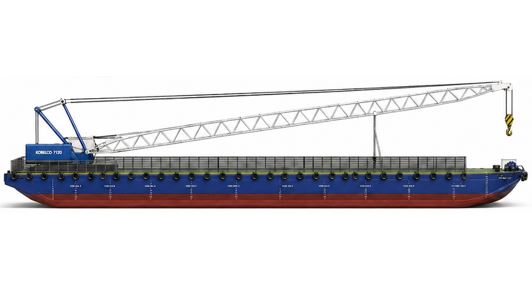
ABSTRACT – Longitudinal strength is a fundamental aspect of barge structural safety because variations in loading magnitude and load position may significantly affect the global hull girder response. This study aims to evaluate the longitudinal strength of a cargo barge based on shear force and still water bending moment under various loading conditions. The object of the study is a cargo barge with principal dimensions of 330 ft × 90 ft × 21 ft and a lightship weight of 1802.9 tons. The analysis was carried out using a still-water longitudinal strength approach based on the distribution of weight and buoyancy along the vessel length. Six loading conditions were investigated, namely lightship, fully loaded, partially loaded at 50%, and three crane-shift positions at the aft, midship, and fore sections. The net load distribution was obtained from the difference between distributed weight and buoyancy, and then integrated to determine the shear force and still water bending moment along the hull. The results show that the fully loaded condition produced the most critical structural response, with a maximum shear force of 0.385 × 10³ ton at Frame 50 and a maximum still water bending moment of -6.212 × 10³ ton·m at Frame 35. In contrast, the lightship condition generated the lowest internal force response. All evaluated loading conditions remained below the permissible shear force and still water bending moment limits, indicating that the barge satisfies the applicable longitudinal strength requirements. The study concludes that the vessel is structurally acceptable under all investigated loading scenarios, with the fully loaded condition representing the governing case for safe operation and load planning.
References
[1] P. Yanakiev, Y. Garbatov, and P. Georgiev, “Advances of Articulated Tug–Barge Transport in Enhancing Shipping Efficiency,” J. Mar. Sci. Eng., vol. 13, no. 8, p. 1451, Jul. 2025, doi: 10.3390/jmse13081451.
[2] F. Bu and H. Nachtmann, “Literature review and comparative analysis of inland waterways transport: ‘Container on Barge,’” Maritime Economics & Logistics, vol. 25, no. 1, pp. 140–173, Mar. 2023, doi: 10.1057/s41278-021-00195-6.
[3] B. Duldner-Borca, L. Hoerandner, B. Bieringer, R. Khanbilverdi, and L.-M. Putz-Egger, “New Design Options for Container Barges with Improved Navigability on the Danube,” Sustainability, vol. 16, no. 11, p. 4613, May 2024, doi: 10.3390/su16114613.
[4] C. H. Jang and D. K. Kim, “An advanced technique to adjust hull girder load: Part 1 = generalisation,” International Journal of Naval Architecture and Ocean Engineering, vol. 17, p. 100645, 2025, doi: 10.1016/j.ijnaoe.2025.100645.
[5] J. Abedin, F. Franklin, and S. M. I. Mahmud, “Linear Longitudinal Strength Analysis of a Multipurpose Cargo Ship under Combined Bending and Torsional Load,” J. Mar. Sci. Eng., vol. 12, no. 1, p. 59, Dec. 2023, doi: 10.3390/jmse12010059.
[6] R. Adiputra, T. Yoshikawa, and E. Erwandi, “Reliability-based assessment of ship hull girder ultimate strength,” Curved and Layered Structures, vol. 10, no. 1, Feb. 2023, doi: 10.1515/cls-2022-0189.
[7] Alamsyah A, Nurcholik SD, Suardi S, Pawarah MU, Jumalia J. The strength and fatigue life analysis of sedan car ramp of the ferry Ro-Ro 5000 GT using finite element method. Kapal: Jurnal Ilmu Pengetahuan dan Teknologi Kelautan. 2021 Jun 14;18(2):101-10. doi: 10.14710/kapal.v18i2.37518
[8] H. Yu, S. Wu, Y. Zhao, W. Liu, and H. Yang, “A Novel Hull Girder Design Methodology for Prediction of the Longitudinal Structural Strength of Ships,” J. Mar. Sci. Eng., vol. 12, no. 12, p. 2368, Dec. 2024, doi: 10.3390/jmse12122368.
[9] N. Ilić and N. Momčilović, “Evaluation of hull girder ultimate strength for dry cargo inland vessels,” Marine Structures, vol. 102, p. 103790, Jul. 2025, doi: 10.1016/j.marstruc.2025.103790.
[10] S. K. Prabu Chelladurai, A. K. Dash, V. Nagarajan, and O. P. Sha, “Longitudinal strength of high block coefficient merchant ships in irregular waves,” Ocean Engineering, vol. 283, p. 115066, Sep. 2023, doi: 10.1016/j.oceaneng.2023.115066.
[11] S. P. Selvia, R. W. Prastianto, and Murdjito, “Longitudinal strength analysis of a crane barge during heavy lifting operation due to variations of trim,” IOP Conf. Ser. Earth Environ. Sci., vol. 1473, no. 1, p. 012003, Mar. 2025, doi: 10.1088/1755-1315/1473/1/012003.
[12] B. Jinga, Y. Yuan, L. Guoa, and W. Tang, “Stress Reconstruction Method for an Ore Carrier Based on Multi-Level Structural Response Fields,” e-Journal of Nondestructive Testing, vol. 31, no. 2, Feb. 2026, doi: 10.58286/32478.
[13] D. Xiang, Y. Yu, and X. Gao, “A numerical critical shear crack model and its application to post‐peak behavior assessment of RC and SFRC beams,” Structural Concrete, vol. 25, no. 4, pp. 2800–2818, Aug. 2024, doi: 10.1002/suco.202300863.
[14] Y. B. Hadasa, Murdjito, R. W. Prastianto, E. B. Djatmiko, Wahyudi, and M. Faiz, “Study on the effects of lifting loads on the longitudinal strength of a crane barge during heavy lifting operations due to various angle of crane rotation,” IOP Conf. Ser. Earth Environ. Sci., vol. 1298, no. 1, p. 012021, Feb. 2024, doi: 10.1088/1755-1315/1298/1/012021.
[15] M. Parulian, N. Nurmawati, and A. Dianiswara, “Stability And Longitudinal Strength Analysis On Barge 400 Ft During Sea Transportation Decommissioning Jacket,” Wave: Jurnal Ilmiah Teknologi Maritim, vol. 18, no. 2, pp. 91–98, Dec. 2024, doi: 10.55981/wave.2024.1910.
[16] N. A. Papadopoulos, M. C. Naoum, G. M. Sapidis, and C. E. Chalioris, “Cracking and Fiber Debonding Identification of Concrete Deep Beams Reinforced with C-FRP Ropes against Shear Using a Real-Time Monitoring System,” Polymers (Basel)., vol. 15, no. 3, p. 473, Jan. 2023, doi: 10.3390/polym15030473.
[17] T. Putranto, M. Kõrgesaar, and K. Tabri, “Application of Equivalent Single Layer Approach for Ultimate Strength Analyses of Ship Hull Girder,” J. Mar. Sci. Eng., vol. 10, no. 10, p. 1530, Oct. 2022, doi: 10.3390/jmse10101530.
[17] D. Li and Z. Chen, “Advanced empirical formulae for the ultimate strength assessment of continuous hull plate under combined biaxial compression and lateral pressure,” Eng. Struct., vol. 285, p. 116041, Jun. 2023, doi: 10.1016/j.engstruct.2023.116041.
[18] A. I. Wulandari, Suardi, Alamsyah, and A. Ciptiandi, “Strength Analysis with Variation of Construction Transverse Watertight Bulkhead On Ship Container 8842 DWT Using Finite Element Method”, IJMEIR, vol. 8, no. 2, pp. 109–116, Jul. 2025. doi: https://doi.org/10.12962/j25481479.v8i2
[19] M. Moshref-Javadi and M. Gandomkar, “Investigating the Effects of Cargo Weight and its Distribution on the Dynamic Performance of a High-Speed Planing Hull,” Pomorstvo, vol. 38, no. 1, pp. 30–42, Jun. 2024, doi: 10.31217/p.38.1.3.
[20] M. Chillemi, F. Cucinotta, and F. Sfravara, “Numerical Analysis and Geometric Assessment of Air Layer Distribution in a Ventilated Planing Hull in Calm Water,” Journal of Marine Science and Application, vol. 25, no. 1, pp. 46–62, Feb. 2026, doi: 10.1007/s11804-025-00685-6.
[21] N. Zhao, B.-Q. Chen, Y.-Q. Zhou, Z.-J. Li, J.-J. Hu, and C. Guedes Soares, “Experimental and numerical investigation on the ultimate strength of a ship hull girder model with deck openings,” Marine Structures, vol. 83, p. 103175, May 2022, doi: 10.1016/j.marstruc.2022.103175.
[22] Y. B. Hadasa, Murdjito, R. W. Prastianto, E. B. Djatmiko, Wahyudi, and M. Faiz, “Study on the effects of lifting loads on the longitudinal strength of a crane barge during heavy lifting operations due to various angle of crane rotation,” IOP Conf. Ser. Earth Environ. Sci., vol. 1298, no. 1, p. 012021, Feb. 2024, doi: 10.1088/1755-1315/1298/1/012021.
[23] J. P. Quispe, S. F. Estefen, M. I. Lourenço, J. H. Chujutalli, and T. Gurova, “Numerical analysis of residual longitudinal strength of a small-scale hull box girder under damage and bending moment,” Marine Systems & Ocean Technology, vol. 20, no. 1, p. 11, Mar. 2025, doi: 10.1007/s40868-024-00157-6.
[24] M. Ibrahim and M. Soliman, “Reliability quantification and ultimate capacity analysis of ship hulls subjected to cyclic bending moments,” Structure and Infrastructure Engineering, vol. 21, no. 11–12, pp. 2083–2100, Dec. 2025, doi: 10.1080/15732479.2025.2560049.
[25] S. Li, Z. Hu, and S. Benson, “Progressive collapse analysis of ship hull girders subjected to extreme cyclic bending,” Marine Structures, vol. 73, p. 102803, Sep. 2020, doi: 10.1016/j.marstruc.2020.102803.
[26] R. Adiputra, T. Yoshikawa, and E. Erwandi, “Reliability-based assessment of ship hull girder ultimate strength,” Curved and Layered Structures, vol. 10, no. 1, Feb. 2023, doi: 10.1515/cls-2022-0189.
[27] M. K. Rizki, P. Y. Arianto, S. Sumarji, and R. Rudianto, “Strength Analysis of Deck A KM. Dharma Kencana V Due to The Addition of Construction With The Finite Element Method,” Indonesian Journal of Maritime Technology, vol. 3, no. 2, Nov. 2025, doi: 10.35718/ismatech.v3i2.8481374.
Downloads
Published
How to Cite
Issue
Section
License
Copyright (c) 2026 Budhi Santoso, Romadhoni, Jamal, Deny Nusyirwan, Naufal Abdurrahman, Zulfaidah Ariyany

This work is licensed under a Creative Commons Attribution-ShareAlike 4.0 International License.