
Analysis of Fin Stabilizer Effects on 100 GT Fishing Vessel Resistance Using Computational Fluid Dynamics
DOI:
https://doi.org/10.35718/ismatech.v4i2.8482320Keywords:
CFD, Fin Stabilizer , Fishing Vessel , Flow Pattern , ResistanceAbstract
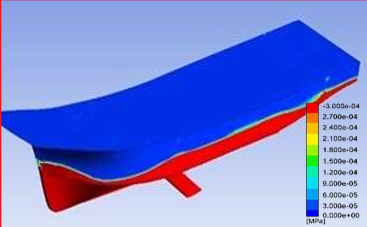
Fishing vessels require good hydrodynamic efficiency to limit propulsion power and energy consumption. Adding a fin stabilizer can modify the flow pattern, pressure distribution, wetted area, and consequently the total resistance; however, studies specifically addressing its resistance effect on a 100 GT fishing vessel remain limited. This study compares the flow characteristics and ship resistance before and after fin-stabilizer installation using Computational Fluid Dynamics (CFD). The hull geometry was developed from a 25 GT fishing-vessel dataset through a scaling approach, producing a working model with an LOA of 42 m, LWL of 40.2 m, beam of 8.3 m, depth of 3.2 m, and draft of 2.3 m. Simulations were performed at 10 knots using the RANS equations, the SST k-omega turbulence model, and a Volume of Fluid approach for the air-water interface. Total resistance decreased from 9425.965 N for the bare hull to 9134.796 N with the fin, corresponding to a 3.089% reduction. Flow visualization also indicated local changes around the fin and in the pressure field. The analyzed configuration therefore reduced resistance under the simulated operating condition.
References
[1] K.-W. Song, C.-Y. Guo, J. Gong, P. Li, and L.-Z. Wang, “Influence of interceptors, stern flaps, and their combinations on the hydrodynamic performance of a deep-vee ship,” Ocean Engineering, vol. 170, pp. 306–320, 2018, doi: 10.1016/j.oceaneng.2018.10.048.
[2] W. Seok, S. Y. Park, and S. H. Rhee, “An experimental study on the stern bottom pressure distribution of a high-speed planing vessel with and without interceptors,” International Journal of Naval Architecture and Ocean Engineering, vol. 12, pp. 691–698, 2020, doi: 10.1016/j.ijnaoe.2020.08.003.
[3] M. Mansoori, A. C. Fernandes, and H. Ghassemi, “Interceptor design for optimum trim control and minimum resistance of planing boats,” Applied Ocean Research, vol. 69, pp. 100–115, 2017, doi: 10.1016/j.apor.2017.10.006.
[4] J. Suneela, P. Krishnankutty, and V. Anantha Subramanian, “Hydrodynamic performance of planing craft with interceptor-flap hybrid combination,” Journal of Ocean Engineering and Marine Energy, 2021, doi: 10.1007/s40722-021-00211-0.
[5] K.-W. Song, C.-Y. Guo, C. Wang, C. Sun, P. Li, and W. Wang, “Numerical analysis of the effects of stern flaps on ship resistance and propulsion performance,” Ocean Engineering, vol. 193, art. no. 106621, 2019, doi: 10.1016/j.oceaneng.2019.106621.
[6] S. Samuel, A. Supriyatin, D. Chrismianto, A. F. Zakki, and D. P. Sari, “Hydrodynamic Analysis of Integrated Interceptor-Stern Flap for Trim Control on High-Speed Planing Vessel,” International Journal of Automotive and Mechanical Engineering, vol. 21, no. 2, pp. 11220–11234, 2024, doi: 10.15282/ijame.21.2.2024.4.0867.
[7] K. Song, J. Gong, J. Ma, Q. Xu, Y. Shi, and F. Xu, “Numerical Study on the Influence of Interceptor and Stern Flap on Ship Resistance and Motion Response in Regular Waves,” Journal of Marine Science and Engineering, vol. 12, art. no. 929, 2024, doi: 10.3390/jmse12060929.
[8] A. M. F. Putra and H. Suzuki, “Experimental and numerical study on the high-speed ship hydrodynamics influenced by an interceptor with varied angle of attack,” International Journal of Naval Architecture and Ocean Engineering, vol. 16, art. no. 100566, 2024, doi: 10.1016/j.ijnaoe.2023.100566.
[9] S. Samuel et al., “Numerical Research on the Influence of Interceptor Flaps on the Planing Hydrodynamic Performance,” Naše more, vol. 70, no. 4, pp. 219–227, 2023, doi: 10.17818/NM/2023/4.4.
[10] Rosmani, S. Baso, A. D. E. Anggriani, L. Bochary, Wahyuddin, M. A. Asis, and A. Ardianti, “An Experimental Study of Hydrodynamic Performance of a Planing Hull Due to the Improvement of Stern Flap: The Effects of Form and Angle,” International Journal of Metacentre, vol. 1, no. 1, 2021.
[11] G. Budynas, Shigley's Mechanical Engineering Design, 9th ed., 2006.
[12] A. Baharullah, Sunarsih, and A. Ismail, “Numerical Analysis of Forward-Facing Reverse-V Step Hull Angle on Resistance Characteristics of Planing Hull,” International Journal of Marine Engineering and Innovation Research, vol. 11, no. 2, pp. 601–610, 2026.
[13] S. Jangam, “CFD based prediction on hydrodynamic effects of Interceptor and flap combination on planing hull,” Ocean Engineering, vol. 264, art. no. 112523, 2022, doi: 10.1016/j.oceaneng.2022.112523.
[14] O. S. Sahin, E. Kahramanoglu, and F. Cakici, “Numerical evaluation on the effects of interceptor layout and blade heights for a prismatic planing hull,” Applied Ocean Research, vol. 127, art. no. 103302, 2022, doi: 10.1016/j.apor.2022.103302.
[15] J. Zou, S. Lu, Y. Jiang, H. Sun, and Z. Li, “Experimental and Numerical Research on the Influence of Stern Flap Mounting Angle on Double-Stepped Planing Hull Hydrodynamic Performance,” Journal of Marine Science and Engineering, vol. 7, no. 10, art. no. 346, 2019, doi: 10.3390/jmse7100346.
[16] O. F. Sukas, O. K. Kinaci, F. Cakici, and M. K. Gokce, “Hydrodynamic assessment of planing hulls using overset grids,” Applied Ocean Research, vol. 65, pp. 35–46, 2017, doi: 10.1016/j.apor.2017.03.015.
[17] R. Khazaee, M. A. Rahmansetayesh, and S. Hajizadeh, “Hydrodynamic evaluation of a planing hull in calm water using RANS and Savitsky's method,” Ocean Engineering, vol. 187, art. no. 106221, 2019, doi: 10.1016/j.oceaneng.2019.106221.
[18] S. Jangam, P. Krishnankutty, and V. Anantha Subramanian, “Numerical investigation on the hydrodynamic performance of high-speed planing hull with transom interceptor,” Ships and Offshore Structures, vol. 15, no. sup1, 2020, doi: 10.1080/17445302.2020.1738134.
[19] R. Ponzini, F. Salvadore, E. Begovic, and C. Bertorello, “Automatic CFD analysis of planing hulls by means of a new web-based application: Usage, experimental data comparison and opportunities,” Ocean Engineering, vol. 210, art. no. 107387, 2020, doi: 10.1016/j.oceaneng.2020.107387.
[20] H. Shen, Q. Xiao, J. Zhou, Y. Su, and X. Bi, “Design of hydrofoil for the resistance improvement of planing boat based on CFD technology,” Ocean Engineering, vol. 255, art. no. 111413, 2022, doi: 10.1016/j.oceaneng.2022.111413.
Downloads
Published
How to Cite
Issue
Section
License
Copyright (c) 2026 RIZQI MUBAROK; Megawati; Dinda, Lilik, mahendra

This work is licensed under a Creative Commons Attribution-ShareAlike 4.0 International License.