
Comparative Analysis of Engine Propeller Matching (EPM) Characteristics Using Empirical Methods and Computational Fluid Dynamics (CFD) for a 5 GT Fishing Vessel
DOI:
https://doi.org/10.35718/ismatech.v4i2.8482014Keywords:
Fishing Vessel, Engine Propeller Matching, Operating Point, Wageningen B Series, CFDAbstract
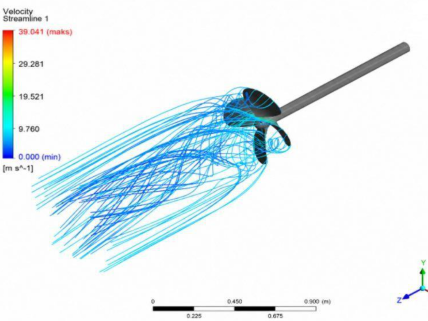
The compatibility between engine and propeller characteristics is a critical factor in determining the performance of a ship’s propulsion system, particularly for small-scale fishing vessels. This study aims to analyze engine-propeller matching (EPM) on a 5 GT fishing vessel using an empirical method based on the Wageningen B-Series and to perform hydrodynamic calculations via Computational Fluid Dynamics (CFD) simulation. Ship resistance calculations were performed using the MARIN (DESPPC) method to determine the required thrust at various operating speeds. Propeller characteristics were determined using Wageningen B-Series data (B4-30, AE/AO = 0.30, P/D = 1.0), while engine characteristics were modeled using a constant power approach.The analysis results show that the optimal operating point occurs at 834 rpm with a torque of 389 Nm. Under these conditions, the propeller is capable of generating a thrust of approximately 3950 N, so the propulsion system is deemed capable of meeting the ship’s operational requirements. CFD simulation results yielded a thrust of 3666.17 N. A comparison between the EPM and CFD methods revealed a 7.2% discrepancy based on thrust. This discrepancy is attributed to the EPM method’s reliance on idealized flow conditions, whereas CFD accounts for viscosity effects, turbulence, and flow distribution more realistically under open-water conditions. Overall, the Engine–Propeller Matching method proved to be effective as an initial approach in the analysis of fishing vessel propulsion systems, with an acceptable level of accuracy following comparison using the CFD numerical method.
References
[1] S. R. Turnock. and D. A. Hudson. A.F. Molland, "Ship Resistance And Propulsion," 2nd ed, Cambridge, United Kingdom: Cambridge University Press, 2017. doi: 10.1017/9781316494196.
[2] D. Stapersma and H. Woud, “Matching propulsion engine with propulsor,” J. Mar. Eng. Technol., vol. 4, no. 2, pp. 25–32, 2005, doi: 10.1080/20464177.2005.11020189.
[3] H. Yudo, “Engine-Propeller Matching on Ships to Optimize the Use of the Ship’s Propulsion Engine and Propeller as a Propulsion Device,” Kapal, vol. 4, no. 1, pp. 15–18, 2012.
[4] M. Tadros, M. Ventura, and C. G. Soares, “Design of propeller series optimizing fuel consumption and propeller efficiency,” J. Mar. Sci. Eng., vol. 9, no. 11, 2021, doi: 10.3390/jmse9111226.
[5] Nurhadi, Sumarsono, “B Case Study of Container Ships 100 TEUs ,” Balai Teknologi Hidrodinamika,vol. 18, no. December, pp. 201–214, 2017.
[6] M. S. Baital, A. B. Putranto, and B. S. Waluyo, “Analysis of Engine-Propeller Matching (EPM) on a Rescue Boat Due to Changes in the Powering Process,” Gema Teknol., vol. 21, no. 1, pp. 49–55, 2020, doi: 10.14710/gt.v21i1.32266.
[7] S. W. Adji et al., “Engine Propeller Matching,” Institut Teknologi Sepuluh Nopember (ITS), Surabaya, pp. 1–31, 2005..
[8] M. Acanfora, F. De Luca, R. Pigazzini, and M. Altosole, “An experimental study on the open water characteristics of a ship propeller in waves,” Appl. Ocean Res., vol. 154, no. November 2024, p. 104331, 2025, doi: 10.1016/j.apor.2024.104331.Eng. Appl., vol. 1, no.1, pp. 50–59, 2024.
[9] I. A. Fajar, M. Jannah, D. Ratna, W. Resources, D. Installation, and H. R. Development, “Technical Analysis of Engine Propeller Matching KRI X After Main Engine Repowering," Int. Journal Marine. Eng. Appl., vol. 1, no. 1, pp. 50–59, 2024.
[10] A. Paska, E. S. Hadi, and Kiryanto, “Analysis of Engine-Propeller Matching on a New Type 200 DWT Pioneer Vessel to Achieve an Optimal Propulsion System,” J. Ship Eng., vol. 4, no. 3, pp. 576–585, 2016.
[11] J. S. Carlton, Marine Propellers and Propulsion, 2nd edition. Cornwall: Butterworth-Heinemann, Elsevier Ltd., 2007.
[12] D. J. Taunton, D. A. Hudson, and R. A. Shenoi, “Characteristics of a series of high-speed hard-chine planing hulls – Part 1: Performance in,” Int. J. Small Cr. Technol., vol. 152, pp. 55–57, 2010, doi: 10.3940/rina.ijsct.2010.b2.96.
[13] C. Kusuma, I. M. Ariana, W. H. Nugroho, M. Indiaryanto, and B. Ali, “Development of an Optimum Design for the B-Series Propeller with Engine-Propeller Matching: A Case Study of a 60-Meter Patrol Boat,” Int. J. Mar. Eng. Innov. Res., vol. 7, no. 1, pp. 116–125, 2022, [Online].
[14] T. G. Tran and H. C. Kim, “A study on the matching problem of engine, propeller, and ship hull under actual service conditions,” Int. J. Nav. Archit. Ocean Eng., vol. 15, 2023, doi: 10.1016/j.ijnaoe.2023.100538.
[15] I. B. Celik, U. Ghia, P. J. Roache, C. J. Freitas, H. Coleman, and P. E. Raad, “Procedure for estimation and reporting of uncertainty due to discretization in CFD applications,” J. Fluids Eng. Trans. ASME, vol. 130, no. 7, pp. 0780011–0780014, 2008, doi: 10.1115/1.2960953.
[16] W. Versteeg, H. K., & Malalasekera, An Introduction to Computational Fluid Dynamics. The Finite Volume Method, NY 10158. England: John Wiley & Sons, Inc., 2007. [
[17] ITTC, “Practical Guidelines for Ship CFD Applications,” ITTC – Recomm. Proced. Guidel. ITTC, pp. 1–8, 2011.
Downloads
Published
How to Cite
Issue
Section
License
Copyright (c) 2026 Berlian Arswendo Adietya, Samuel Samuel, Paulina Wahyu Hariyani, Muhammad Rizal Fadillah, Muhammad Afwan Yusuf Yusuf, Widyartisto Widyartisto, Ardi Nugroho Yulianto, Jamal Jamal, Mahendra Indiaryanto

This work is licensed under a Creative Commons Attribution-ShareAlike 4.0 International License.